

The Health (Amendment) (Home Support Providers) Act 2026 was signed into law on 1 July 2026. It has not commenced. Section 1(2) allows the Minister to bring different provisions into operation on different days, which means statutory regulation of home support now exists on the statute book without yet applying to anybody.
A commencement period of up to twelve months was envisaged, the Minister of State told Committee Stage, to allow ministerial regulations, HIQA national standards and guidance to be developed. That was reported by William Fry in July 2026. No commencement order has been made, so the timing of statutory regulation is not yet known.
That gap is the most useful thing a provider has right now, and it is the thing most likely to be wasted. Statutory regulation arrives with two deadlines attached, and the work that satisfies them is slow work rather than paperwork that can be produced in a fortnight.
On this page
What has happened so far, and what has not?
The Act is law and is not yet in force. Statutory regulation was created on 1 July 2026, when the Health (Amendment) (Home Support Providers) Act 2026, No. 17 of 2026, was enacted and inserted a new Part 8A into the Health Act 2007.
The operative prohibition is section 69C of the Act as enacted: a person shall not carry on the business of a home support provider unless registered. Enforcement sits with HIQA through the Chief Inspector of Social Services, and operating unregistered is a criminal offence. Those are the teeth of statutory regulation, and they are not ambiguous.
The Act also leaves a great deal to be filled in. It creates the registration duty, the register and the enforcement powers, and it sets no training requirements of its own, leaving the detailed obligations to ministerial regulations and to national standards HIQA has yet to finalise.
What has not happened is most of the detail. The ministerial regulations that will sit beneath the Act have not been made, HIQA’s national standards for home support remain in draft, and no commencement order has been signed. Statutory regulation is a known destination with an unknown departure time, and what the Act actually says is the only firm ground available.
When does the clock for statutory regulation actually start?
Both transitional clocks run from the commencement of section 69C specifically, not from the commencement of the Act as a whole. Section 69ZD(2) and section 69ZD(3) each fix their deadline by reference to the date on which section 69C comes into operation.
The distinction is not academic. Section 1(2) allows the Minister to commence different provisions on different days, so parts of the Act could be brought into operation well before section 69C is, and a provider counting from the wrong date would be counting from a date with no bearing on its duties. Most published commentary on statutory regulation simplifies this incorrectly.
The practical consequence is a single diary entry. Watch for the commencement order that brings section 69C into operation, because that is the date from which three months and two years are measured. Everything else about statutory regulation can be read at leisure. That one date cannot.

What are the two deadlines, and which one deserves attention?
Existing providers carry two duties on a timetable: notify the chief inspector within three months, and apply for registration within two years. Section 69ZD(2) sets the notification, section 69ZD(3) sets the application, and both run from the day section 69C comes into operation rather than from the day the Act commences.
Three months is a notification, and it is straightforward. Two years is the one that deserves attention, because an application for registration is not a form filled in on the day. It is a description of how an organisation is governed, staffed, trained and evidenced, and it will be read by somebody whose job is to test whether the description matches the service.
| Duty | Section | Timing |
|---|---|---|
| Notify the chief inspector that you are an existing provider | 69ZD(2) | No later than 3 months after section 69C comes into operation |
| Apply for registration | 69ZD(3) | No later than 2 years after section 69C comes into operation |
| Continue to provide the service pending a decision | 69ZD(1) | Permitted, conditional on complying with both duties above |
| Registration once granted | 69F(2) | Has effect for 3 years |
Two years sounds generous until you work backwards from it. Recruitment cycles, supervision cycles, competency assessment across a full roster and the slow accumulation of a credible record take months rather than weeks, and statutory regulation will be assessing the record rather than the intention behind it.
What does an application under statutory regulation actually describe?
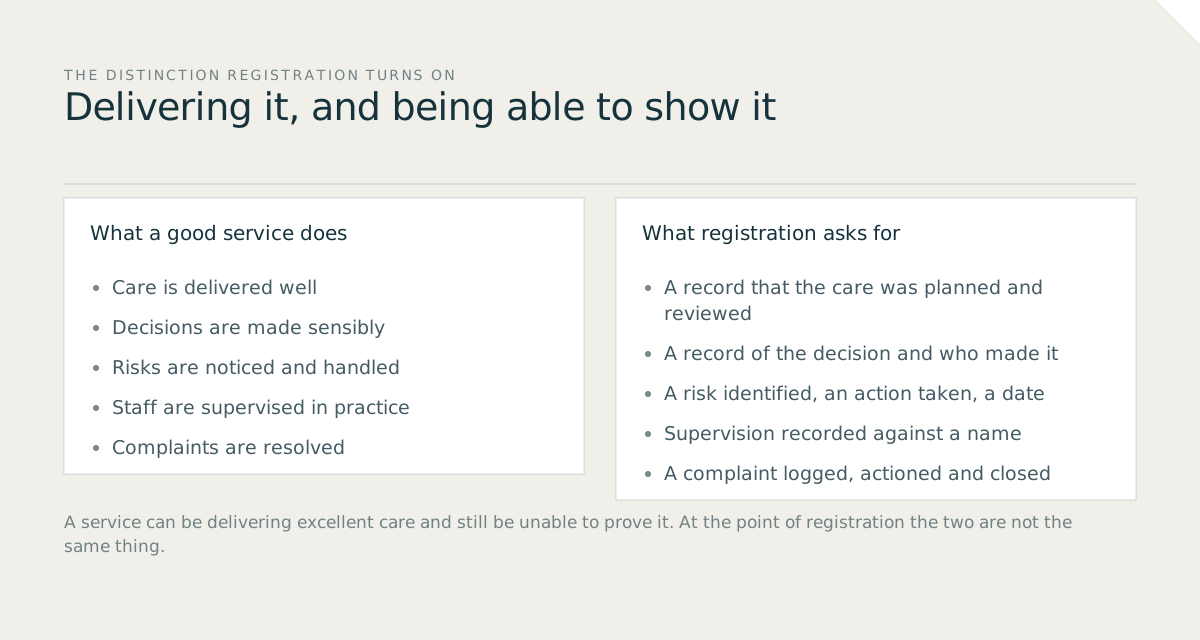
An application for registration describes an organisation rather than a set of intentions. Statutory regulation asks whether governance operates in practice, whether staff are trained and demonstrably competent, whether risks are actively managed, and whether safe, person-centred care is evidenced rather than asserted.
A service can be delivering excellent care and still be unable to prove it, and at the point of registration the two are not the same thing. That gap is where most preparation work sits, and it is very rarely a gap in the care itself.
Read from that angle, preparing for statutory regulation is less about acquiring documents and more about changing how records are made in the ordinary course of a week. A supervision session that leaves a dated, signed note is assessable. The same session, conducted just as well and never written down, is not.
What is the transitional register, and can you keep trading?
The chief inspector will establish and maintain a register of notified existing providers and make it available on the internet, under section 69ZD(4) and (5). Section 69ZD(1) allows an existing provider to continue providing the service pending a decision by the chief inspector, conditional on complying with the notification and application duties.
A publicly accessible transitional register changes the visibility of statutory regulation. Commissioners, families, discharge teams and competitors will be able to look up who notified and who did not, and absence from a public list tends to get raised in a tender conversation long before a regulator raises it.
The permission to keep trading is worth reading precisely. It is conditional rather than automatic, and it depends on having notified in time and applied in time. Miss either duty and the protection that lets an existing provider operate while a decision is pending falls away, which is the sharpest edge in the transitional arrangements.
Being named on the transitional register is not the same as being registered. The register records that a provider notified and is trading while a decision is pending, which is a different statement from having satisfied statutory regulation, and it is worth describing accurately in tender responses and in anything a family reads.
How long does registration last, and what will it cost?
Registration has effect for three years under section 69F(2). Cost is the part nobody can answer yet, because section 69E(2)(c) requires an application to be accompanied by the prescribed application fee and section 99(3)(e) allows an annual fee to be prescribed, and no fees have been prescribed to date.
A three year cycle is a planning fact rather than a footnote. Statutory regulation on a three year renewal means the evidence base has to survive between renewals instead of being assembled for each one, and a provider that treats registration as a single exercise will rebuild the same file from scratch every third year.
On fees, the sensible posture is to budget for an unknown rather than to assume there is nothing to budget for. Fees require regulations that do not yet exist, and when they arrive they will land on every provider inside statutory regulation at the same time.
Renewal also changes what a good year looks like. The question worth asking each December is not whether the service got through the year, but whether the record of that year would stand on its own if read cold by somebody who was not there, because that record is what a renewal application is made of.
Does statutory regulation apply to your organisation at all?
Statutory regulation applies to the business of providing a home support service, and section 69B(2) excludes six categories from it. Checking which side of that line an organisation sits on is worth an hour of somebody’s time before either answer is assumed.
The definition itself is broad. A home support service is support provided to a service user by reason of illness, frailty or disability, in relation to activities of daily living, instrumental activities of daily living, or other activities, where it is primarily provided in the service user’s private dwelling. Nothing in that definition is limited by age.
- A person who provides a home support service to fewer than four persons.
- An individual who provides a home support service without commercial gain.
- A person providing services under HSE section 38 or section 39 arrangements where the terms require the service users themselves to direct how services are provided, which preserves personal assistant services.
- A person providing a home support service in that person’s capacity as a member of a relevant profession within the meaning of the Health and Social Care Professionals Act 2005.
- Foster care placements under the Child Care Act 1991.
- A person carrying on the business of an employment agency who is not involved in organising or managing the provision of a home support service.
Two of those repay a second reading. The threshold of fewer than four persons is a live question for very small providers, and the employment agency exclusion turns entirely on whether the agency is involved in organising or managing the service. Scope is the cheapest thing to get wrong about statutory regulation and the most expensive to discover late.
What has HIQA published, and what is still missing?
HIQA has published draft National Standards for Home Support Services and, for home support specifically, very little else. The draft standards appeared in November 2024, consultation ran from 4 November to 13 December 2024, and they remain in draft as of September 2026.
The draft sets out four principles and thirteen standards, each written in the first person from the service user’s point of view with a corresponding provider requirement attached. That phrasing is a clue to how statutory regulation is likely to be tested: by asking whether a person receiving the service would recognise the description the provider gives of it.
What is missing is the machinery. HIQA has published no inspection framework, no assessment judgment framework, no registration handbook and no fee schedule for home support. Its published guidance for providers covers healthcare, children’s, disability, older people’s and International Protection Accommodation services, and home support is not among them.
That absence argues for preparing against the draft standards and the Act rather than waiting for a document. The substance of statutory regulation, meaning governance, staffing, risk and evidence, will not be reinvented by a framework. A framework will describe how those things are tested, not what they are.

What should you do before statutory regulation commences?
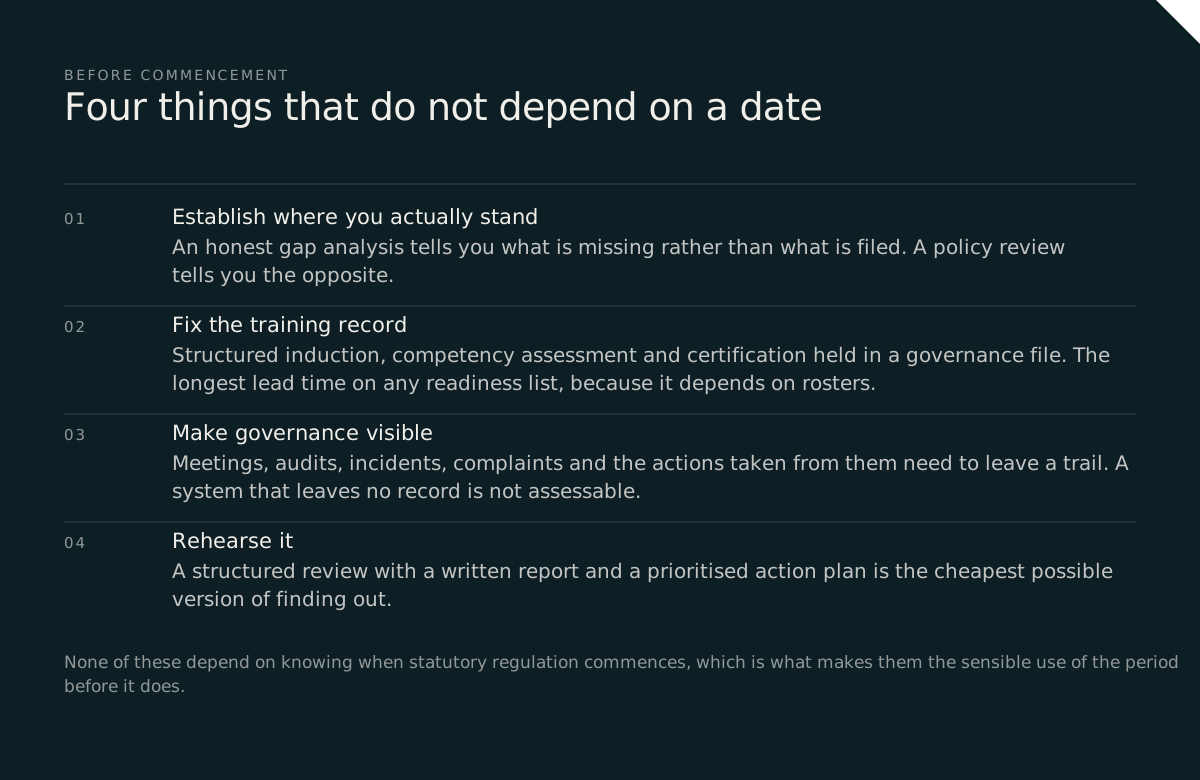
Four pieces of work are worth starting now, and not one of them depends on knowing the commencement date. Statutory regulation will ask for evidence that takes months to accumulate, so the order in which the work is done matters more than the hours put into it.
- Run an honest gap analysis against the draft standards and the duties in the Act, written down, with named owners and dates rather than a general sense of where the weak points are.
- Fix the training record, so that it shows structured induction, completed training and assessed competence for each named member of staff rather than attendance at sessions.
- Make governance visible, so that decisions, escalations, audits and reviews leave a dated trail. If a system operates but leaves no record, it will not be assessable.
- Rehearse it with a structured mock inspection that produces a written report and a prioritised corrective action plan, not a verbal impression.
The second item is usually the largest. A training record that captures attendance but not competence answers a different question from the one statutory regulation will ask, and rebuilding it means observing people at work, over months, rather than reprinting certificates.
The fourth is the one providers postpone longest. A structured mock inspection tells you what an outside reader makes of your records, which is a materially different thing from what you believe those records contain, and it does so while there is still time to act on the answer.
Why does waiting for statutory regulation cost more?
Deadline pressure changes what a fix costs. A gap found early is a scheduling problem, and the same gap found a month before a deadline is a procurement problem, which is a different price and usually a worse outcome.
Reconstructed records are visibly reconstructed. Twelve supervision notes written in the same hand in the same week, covering the previous eighteen months, do not read as a system that was operating. They read as a system that was assembled, and statutory regulation will be assessed by people who read records for a living.
There is a supply argument as well. The Department of Health’s Regulatory Impact Analysis estimated about 200 home support providers in Ireland and up to 29,000 home support workers across all sectors, figures cited in the Oireachtas Bill Digest of 9 February 2026.
Two hundred organisations is a small market with a finite number of trainers, assessors and external reviewers serving it. When statutory regulation commences, demand for training delivery, competency assessment and independent review will concentrate into one window, and the providers that left it late will be buying in the tightest part of that market. Sensible compliance work is cheaper before everyone wants it.
Is statutory regulation something the sector asked for?
Much of the sector argued for statutory regulation. The Department of Health’s consultation on draft home support regulations, reported in January 2023, drew 210 submissions, 36 of them from home support providers or networks, and one of the steadiest themes was that providers meeting a standard were being undercut by providers meeting none.
One submission put it plainly: “Providers who deliver services in line with best practice can be disadvantaged when competing with providers who are not delivering services to any recognised standards and therefore are able to deliver their services at a lower cost.”
That is the case for statutory regulation stated by the people it will regulate. A common standard removes the cost advantage of not meeting one, and a provider already operating to a recognised standard has considerably less to fear from statutory regulation than from its continued absence.
The same consultation carried a caution worth keeping in view, that implementation should not reduce the number of staff currently working in services or have a chilling effect on the numbers considering the sector. Proportionate preparation, spread over the time available, serves that caution better than a scramble at the end of it.
The aim is not to prepare an organisation to pass an inspection. It is to build systems that support ongoing quality, safety and compliance, and then to be able to show them. Statutory regulation is the occasion for that work rather than the reason for it.
CareReady is an Irish compliance and training consultancy working with private home support organisations. The work is preparation: getting governance, training records and evidence into a state that holds up when somebody outside the organisation reads them.
Sources: Health (Amendment) (Home Support Providers) Act 2026, as enacted · William Fry, Home Support Providers Act signed into law