

In November 2025 HIQA published a record of what the sector told it while the national standards for home support were being developed. Fifty one home support providers took part in focus groups and eighty organisations responded to the consultation on the draft standards. Among the things they asked for was a first HIQA inspection that pointed out areas for improvement rather than passing or failing the service.
That is a reasonable thing to want. It is also not what a statutory registration inspection is designed to do, and the distance between those two positions is worth setting out carefully, because that distance is where a good deal of avoidable disappointment is going to happen.
What follows is drawn from HIQA’s own stakeholder report and from the draft standards. No inspection framework has been published for home support, so nobody can describe what a HIQA inspection of a home support service will look like in detail. What can be described is what providers asked for, what inspection under a registration regime exists to do, and where the two do not meet.
On this page
What did HIQA ask home support providers?
HIQA ran focus groups and a public consultation while developing the Draft National Standards for Home Support Services. The Home Support Standards Stakeholder Involvement Report, published in November 2025, records what it heard: 51 home support providers took part in the focus groups, and 80 organisations responded to the consultation on the draft standards.
The draft standards were published in November 2024, with consultation running from 4 November to 13 December 2024. They were still in draft in September 2026. There are four principles and thirteen standards, each written in the first person from the service user’s point of view, each carrying a matching requirement on the provider.
The stakeholder report is a primary source and it is barely read. Very little published commentary on HIQA inspection of home support draws on it at all, which is a pity, because it is the only public record of what the sector itself said about being regulated.
It contains several things that appear nowhere else. One of them is a direct request about how the first HIQA inspection ought to work, and reading that request alongside the Act explains most of what providers are likely to find surprising about HIQA inspection when it finally arrives.

What did providers say they wanted from HIQA inspection?
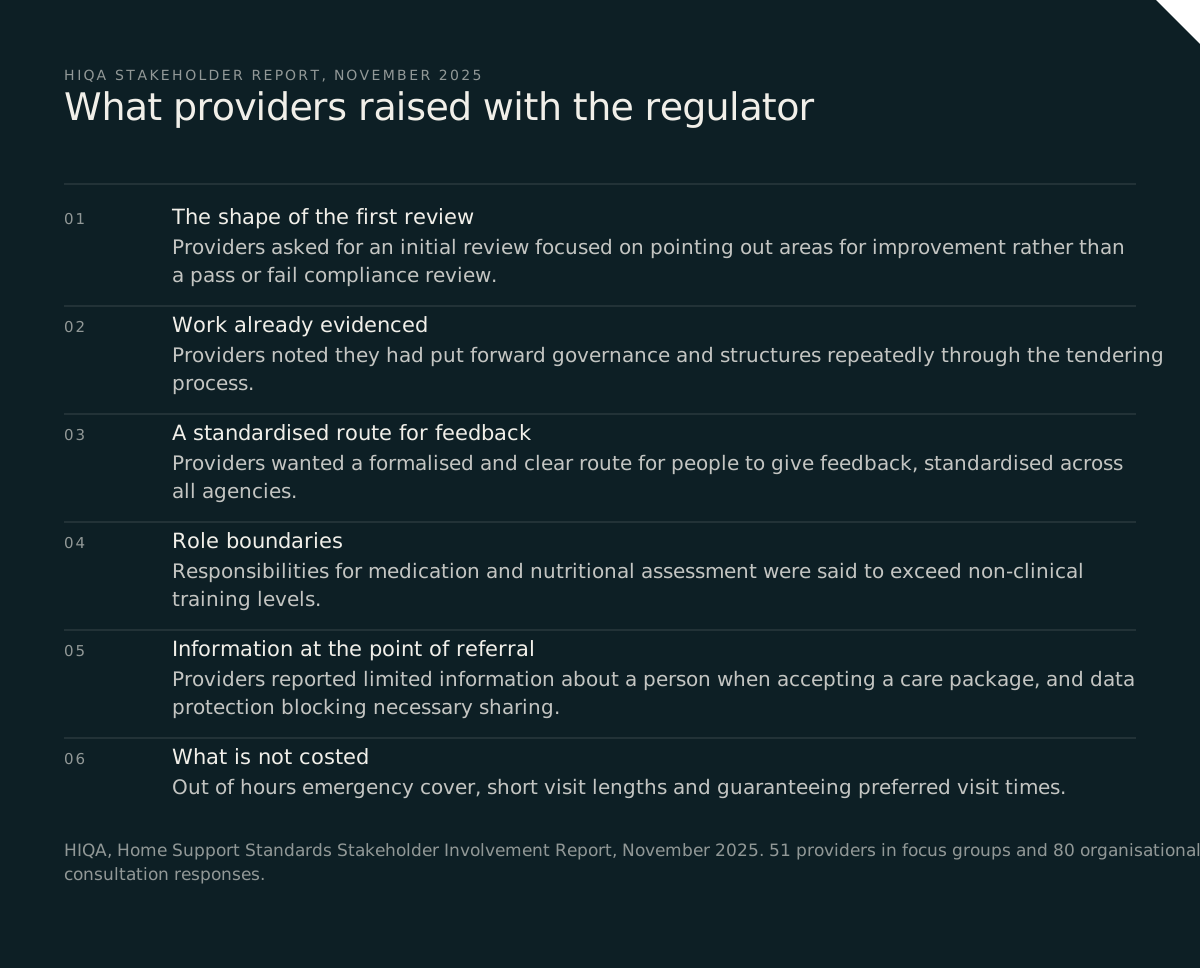
Providers asked for a first HIQA inspection that was developmental rather than judgmental. The report records the request in the sector’s own words: “An initial review by HIQA which is focused on pointing out areas for improvement rather than purely a ‘compliance’, fail/pass review would help”.
Read that carefully, because it is not a request to be let off. It is a request for the first HIQA inspection to function as a diagnostic. Tell us what is wrong, give us the chance to fix it, and judge us after that.
The reasoning behind it surfaces elsewhere in the same report, in a provider describing years of proving the same things to commissioners: “we’ve been doing it all along… it’s all there you know and we’ve had to kind of prove this every time… under the tendering process we would have had to put forward all of our governance and structures and what’s in place.”
That is the voice of an organisation that has been assessed repeatedly and has not found the exercise useful. Wanting the first HIQA inspection to be something other than one more proving exercise is an entirely rational response to that history.
Why will the first HIQA inspection probably not work that way?
A HIQA inspection under the new registration regime will exist to establish whether a service meets the standards, because registration will be a condition of trading. Under the Health (Amendment) (Home Support Providers) Act 2026, a person shall not carry on the business of a home support provider unless registered, and operating without registration is a criminal offence.
That fixes the purpose of inspection before anybody sits down to design a framework. Where registration functions as a licence to trade, the first question a HIQA inspection has to answer is whether the service meets the standard on which the licence depends. A developmental review answers a different question, which is how the service could be better.
Both questions are worth asking. They are not the same instrument, and one cannot quietly become the other. A regulator that told a service falling short only how it might improve, and registered it anyway, would have converted registration into a formality, which is the one outcome that would help nobody in the sector.
None of this makes the providers wrong. It makes the request one that a HIQA inspection cannot satisfy, which means the developmental review they asked for has to come from somewhere other than the regulator.
What is a registration inspection actually for?
A registration inspection establishes whether a service meets the conditions on which its registration depends, and a HIQA inspection of a home support service will be an inspection of that kind. The output is a judgment and a decision rather than a set of suggestions, and the decision carries commercial consequences, because registration is what permits the service to trade.
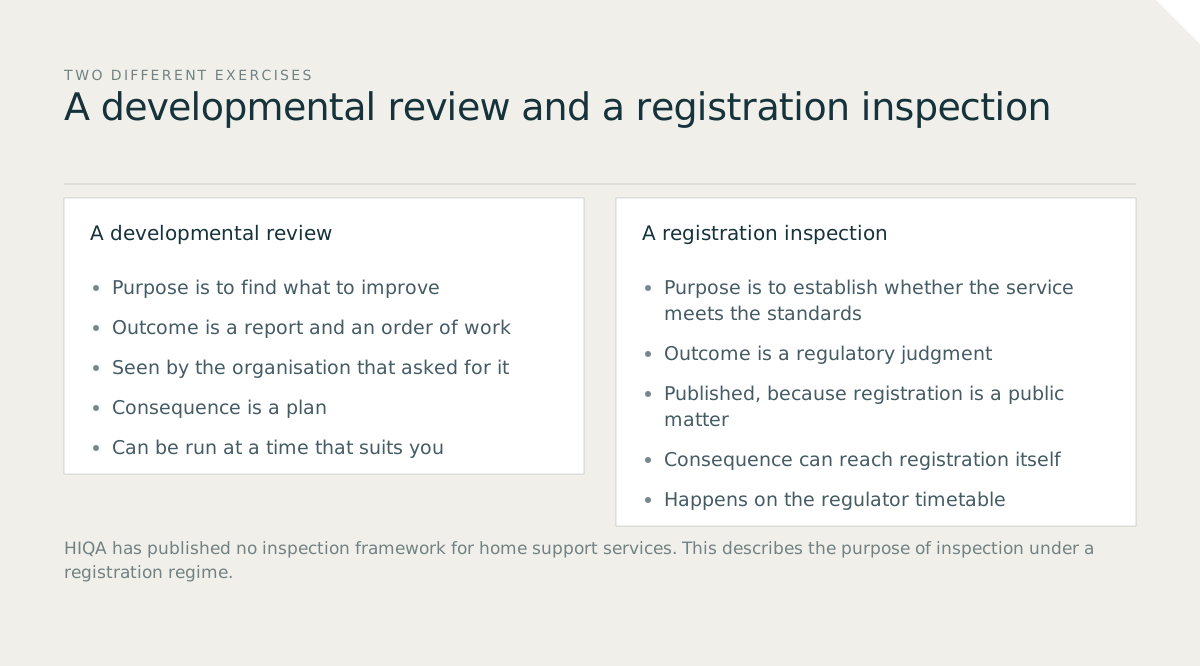
Set the two instruments side by side and the difference turns out not to be one of tone.
| Developmental review | Statutory registration inspection | |
|---|---|---|
| Purpose | To identify areas for improvement and help the service get better | To establish whether the service meets the standards on which registration depends |
| Outcome | Observations and recommendations | A judgment, and a decision on registration |
| Who sets the scope | The service | The regulator |
| Who sees the result | The service, and whoever it chooses to show | The regulator, and in a registration regime the public |
| Consequence of a poor result | An improvement plan and a follow up | Conditions, refusal or cancellation of registration |
| Timing | Whenever the service chooses | When the regulator decides |
The row that matters most is the fifth. A developmental review that finds serious problems produces an improvement plan. A HIQA inspection that finds serious problems can produce conditions on registration, refusal or cancellation, and in a sector where registration is a precondition of trading those are not equivalent outcomes.
The other difference worth noticing is scope. In a developmental review the service chooses what gets examined. In a HIQA inspection the regulator does, and a service that has prepared only the areas it expected to be asked about tends to discover that in the least useful way available.
What else did providers raise?
The stakeholder report records a set of operational problems that have little to do with inspection technique and a great deal to do with whether a service can meet the standards in the first place. None of them would be described as a HIQA inspection issue by the provider raising it. Providers raised six in particular.
- Role boundaries. Responsibilities placed on home support workers for medication and nutritional assessment that exceeded non-clinical training levels.
- Data protection. Interpretations of data protection obligations that blocked information sharing the service needed in order to deliver care safely.
- Information at the point of acceptance. Limited information about a person at the moment the decision to accept a care package has to be made.
- Out of hours cover. Emergency cover outside normal hours not being costed.
- Visit length. Short visits limiting the scope for genuinely person-centred support.
- Preferred visit times. Difficulty guaranteeing the times service users would prefer.
Most of those will surface at a HIQA inspection even though none of them is, strictly speaking, an inspection problem. A service that cannot guarantee preferred visit times is measured against standard 2.2, under which the service user says their care and support is provided in a tailored and timely way. A service where role boundaries are unclear is measured against standard 3.3.
Standard 3.3 requires the provider to have systems and structures ensuring staff have the skills, training and experience to deliver safe and effective care, and that staff are supported and supervised. Where a worker is being asked to do something above their training level, that is a training and supervision question long before it is an inspection question.
Here is the uncomfortable part. Several of these constraints are set by commissioning arrangements and funding rather than by the provider, and a HIQA inspection assesses the service that results from them. The provider carries the finding either way, which is an argument for recording the constraint rather than absorbing it in silence.
What did providers say about complaints and feedback?
Providers asked for a standardised complaints route across the sector, not simply a requirement that each of them have one. The report quotes the point directly: “There’s a lot there about you know, receiving complaints and having a process in place for doing that. And I do think that there should be some formalised and clear route for people to do that… so a form or a route that you can take to give… your feedback that’s standardised across all agencies.”
That maps onto standard 1.4 of the draft standards, in which the service user says they have regular opportunities to give feedback and that their feedback, concerns, complaints or compliments are listened to, recorded and managed in a timely way. The provider requirement is arrangements for managing and responding to these in a timely way, clearly communicated and accessible. Standard 1.4 is one of the more predictable subjects of a HIQA inspection, because the evidence it calls for is documentary.
Note what the standard does not do. It does not prescribe the form. A HIQA inspection will be looking for arrangements that work, and the evidence that they work is a log with real entries, real dates and real outcomes, rather than a policy describing a process nobody has used.
The request for standardisation is understandable, and it is the kind of thing final standards or guidance could still address. Until they do, each provider designs its own route, hands it to service users and demonstrates that it is used. An empty complaints log is not a good result at a HIQA inspection. It is an unanswered question.

Do providers want regulation, or fear it?
The evidence points more towards wanting it than fearing it. The Department of Health’s consultation on draft home support regulations, reported in January 2023, drew 210 submissions, 36 of them from home support providers or networks, and one of the clearest themes was that providers working to a recognised standard feel undercut by providers working to none.
The submissions put it plainly: “Providers who deliver services in line with best practice can be disadvantaged when competing with providers who are not delivering services to any recognised standards and therefore are able to deliver their services at a lower cost.”
That is an argument for regulation made by the regulated. An organisation carrying the cost of training, supervision, competency assessment and governance is at a price disadvantage against one carrying none of it, and only an enforced standard closes that gap. A HIQA inspection is the mechanism that makes a standard real rather than declared.
The same consultation recorded two cautions worth keeping in view. One was about workforce: “It is essential that the effect of the implementation of the regulations is not to reduce the number of staff currently working in services or to have a chilling effect on the numbers of staff considering working in this sector.” The other was about contracts: “This is the first time we have been notified of contracts between clients and providers and will lead into a legal contractual relationship that has not existed in previous homecare tenders.”
Both are about consequences rather than objections. Anxiety about a HIQA inspection is not the same thing as opposition to regulation, and the two get conflated constantly. Taken with the focus group material, the picture is of a sector that broadly wants the standard enforced and is uneasy about how enforcement will feel. Wanting a developmental first HIQA inspection fits that picture precisely.
What do we actually know about how HIQA inspection of home support will work?
Very little, and that is worth saying out loud. HIQA has published no inspection framework, no assessment judgment framework, no registration handbook and no fee schedule for home support, so nobody can describe a HIQA inspection of a home support service in any detail.
HIQA’s published guidance for providers covers healthcare services, children’s services, disability services, older people’s services and International Protection Accommodation services. Home support is not among them. The standards themselves remain in draft, and the consultation that informed them closed in December 2024.
What can be described is the purpose, which is fixed by the Act rather than by HIQA, and the subject matter, which is fixed by the draft standards. A HIQA inspection will test whether the provider has the arrangements the standards require, because that is the form the provider requirement takes in every one of the thirteen.
Read the draft standards and the same phrasing repeats: the provider has arrangements in place. Arrangements are not intentions. An arrangement that exists only in a policy document is exactly the thing a HIQA inspection is well placed to detect, because the absence of records is itself the finding.
What can a provider do about the gap?
The developmental review that providers asked for is still available to them, but not from the regulator. A service that wants to be told what is wrong before it is judged has to arrange that assessment itself, against the published draft standards, and treat the result as work rather than as reassurance. A HIQA inspection is a different instrument with a different job, and it will not do this one.
The practical version of that is narrower than it sounds.
- Take the thirteen draft standards as written and ask, for each one, what document would prove the arrangement exists.
- Go and find that document. Note where it does not exist, where it exists but is out of date, and where it exists but nobody outside the organisation could follow it.
- Fix the third category first. Records a stranger cannot follow are the most common weakness and the cheapest to correct.
- Repeat it on a cycle rather than once, because the standards will be finalised and the evidence has to survive that change.
None of that requires knowing the inspection framework. The provider requirement in every one of the thirteen standards concerns arrangements, and whether an arrangement exists is a question that can be answered today, without waiting to see what a HIQA inspection asks for.
Some organisations run that exercise internally. Others prefer an outside reader, on the straightforward ground that a person who did not write the records is better at noticing what is missing from them. That is all a mock inspection is, and the exercise is the same either way.
One caution to close on. A rehearsal against draft standards is a rehearsal and not a prediction, and nobody should present it as a forecast of what a HIQA inspection will find, least of all while the standards are unfinished. What it can do is answer the question the sector put to HIQA in the first place: where is this service weak, and what would it take to fix it, while there is still time.
CareReady is an Irish compliance and training consultancy working with private home support providers in Ireland. The work is preparation: reading a service’s records the way an outside reader will, and closing the distance between what the organisation does and what it can show.
Sources: HIQA Home Support Standards Stakeholder Involvement Report, November 2025 · HIQA Draft National Standards for Home Support Services