

Most providers, asked whether they are inspection ready, reach for the policy folder. It is the wrong instinct, and it is an understandable one, because the policy folder is the part of compliance that can be finished.
One complication has to be said plainly before anything else. HIQA has published no inspection framework for home support, so being inspection ready today means being ready against the draft national standards and the Health (Amendment) (Home Support Providers) Act 2026 rather than against a published framework. Anyone claiming otherwise is describing a document that does not exist.
That does not make the question unanswerable. What an inspection looks for is not mysterious: whether a service does what it says it does, and whether it can show it. An organisation that can answer both is inspection ready in the only sense currently available.
On this page
What does inspection ready actually mean right now?
Inspection ready currently means ready against the draft National Standards for Home Support Services and the duties in the Act, because nothing more specific has been published. HIQA has issued no inspection framework, no assessment judgment framework, no registration handbook and no fee schedule for home support.
HIQA’s guidance for providers covers healthcare, children’s, disability, older people’s and International Protection Accommodation services. Home support is not among them, and that absence is the reason so much commentary about being inspection ready is vague about what, precisely, a provider would be ready for.
The draft standards remain the right target in the meantime. Published in November 2024, consulted on from 4 November to 13 December 2024 and still in draft as of September 2026, they set out four principles and thirteen standards, each written in the first person from the service user’s point of view with a provider requirement attached.
Preparing against a draft feels unsatisfactory, and it is still the best available ground. The substance of being inspection ready, meaning governance, staffing, risk and evidence, will not be replaced by whatever framework eventually issues. A framework will describe how those things are judged, not what they are.
Why is the policy folder the wrong instinct?
A policy folder is finite, and that is exactly its appeal. Policies can be drafted, reviewed, dated and shelved, and the folder then looks like a completed task in a domain where very little else ever looks complete.
Policies on a shelf are not evidence. An inspection looks for what happens in practice and for the record that proves it, which makes a policy the beginning of the question rather than the answer to it.
A provider can hold a carefully written safeguarding policy and still be unable to show that a concern raised last March was recorded, escalated, acted on and closed. The policy describes the intended system. The record is the only proof that the system ran, and being inspection ready depends on the second one.
The instinct is worth naming because it is expensive. Hours spent rewriting a policy that was already adequate are hours not spent on the supervision record, and a service that is not inspection ready is very rarely failing on the wording of its documents.

What is actually assessed?
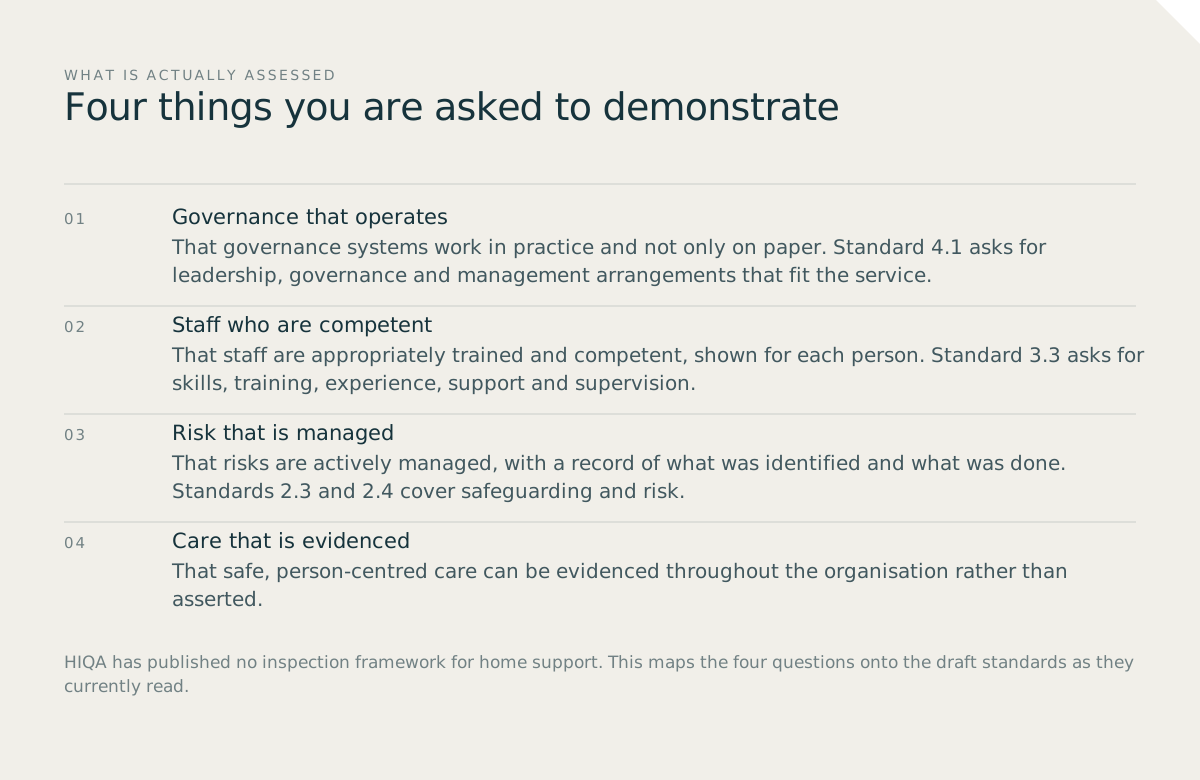
Four things are assessed, and the existence of a document is not one of them. Inspection asks whether governance operates effectively in practice rather than only on paper, whether staff are appropriately trained and competent, whether risks are actively managed, and whether safe, person-centred care is evidenced throughout.
- Governance that operates effectively in practice, not only on paper.
- Staff who are appropriately trained and competent, shown for each named person rather than in aggregate.
- Risks that are actively managed, with a record of what was identified and what was done about it.
- Safe, person-centred care that is evidenced throughout rather than asserted at the front of a document.
Notice how each of the four is phrased. None of them asks whether a provider has a policy on the subject. Each asks whether something is happening and can be shown, and that distinction is what separates an inspection ready service from a well documented one.
An organisation can hold a perfect set of policies and fail all four. That sentence is the whole argument in miniature, and it explains why inspection ready work usually starts in rosters, supervision notes and incident logs rather than in a document library.
How do the draft standards map onto those four things?
The draft standards line up with the four assessment areas closely enough to serve as a working checklist. Standard 4.1 covers governance, standard 3.3 covers staff skills and supervision, standard 2.4 covers risk and standard 2.3 covers safeguarding, and each carries a provider requirement expressed in plain terms. Used that way, the inspection ready question takes a shape: four areas, four requirements, and a record to produce for each.
| What is assessed | Draft standard | What the provider must show |
|---|---|---|
| Governance in practice | 4.1 | Effective leadership, governance and management arrangements reflecting the type of service delivered, including compliance with relevant legislation, standards and policies |
| Trained and competent staff | 3.3 | Systems and structures ensuring staff have the skills, training and experience to deliver safe and effective care, and that staff are supported and supervised |
| Risk actively managed | 2.4 | Arrangements to identify aspects of delivery associated with possible increased risk of harm, and measures put in place to reduce those risks |
| Safeguarding | 2.3 | Arrangements to safeguard people from harm and abuse through consistent implementation of relevant standards, legislation, policy and guidance |
Standard 4.1 is the one most providers underestimate. The requirement describes a working system rather than an organisational chart, and a service that cannot show how a decision was made, escalated and reviewed will struggle to evidence it however clear the reporting lines look on a diagram.
Standard 3.3 is the one most likely to expose a training record. Supervision is named explicitly in it, alongside skills, training and experience, so a provider that trains well but supervises informally has a visible gap. Closing that gap is slow, which is why it belongs early on any inspection ready plan.
Where is the gap between doing it and showing it?
The gap sits between practice and record, and it is almost always wider than a provider expects. At inspection, undocumented good practice is indistinguishable from no practice at all.
That is not an unfair standard. An inspector cannot verify what an organisation remembers, only what it can produce.
Most services in this position are not badly run. They are run by people who solve problems as they arise, resolve them properly and move on to the next call without writing down what happened, which is admirable in the moment and invisible six months later. Being inspection ready asks them to leave a trace.
Closing the gap is mostly a change to habit rather than to effort. A phone call that ends with two lines in a client record, a supervision that ends with a dated note, an incident that ends with a closure entry: each takes minutes, and together they are most of what being inspection ready consists of.
Can your service pass the random staff member test?
Pick a member of staff at random and try to assemble, from your own records and without asking anyone, the evidence that they were inducted, trained, assessed as competent and supervised since. If that takes more than a few minutes, it is a finding waiting to happen.
The test is deliberately unkind in one respect: no asking colleagues. An inspection ready organisation holds the answer in its records, not in the memory of a coordinator who has been there nine years and knows where everything is.
What usually goes wrong is dispersal rather than absence. The vetting is in one system, the certificates are in a shared drive, the competency assessment is an email attachment and the supervision note is in a branch filing cabinet, so the evidence exists but cannot be produced as a single file on request.
The same test works on the client side and is worth running immediately afterwards. Pick a service user at random and produce the support plan, the date of the last review, the risk assessment, any incident record and the evidence that the person was involved in planning their own care. Both halves of that exercise tell you more about whether you are inspection ready than a fortnight of policy review will.
Why is a self-audit not the same as an outside review?
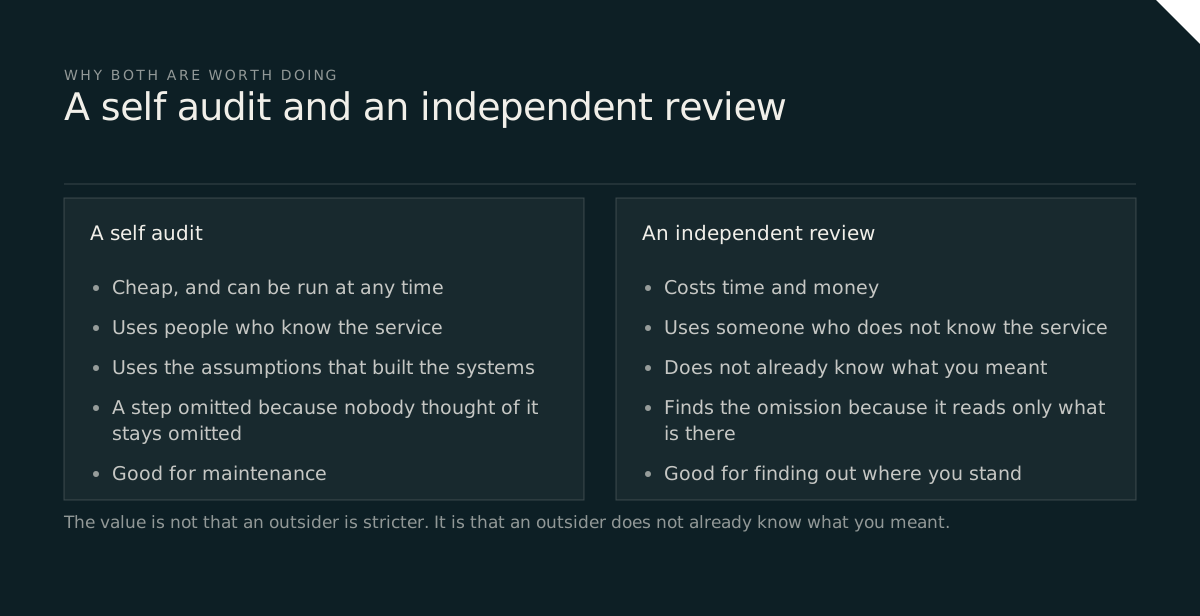
A self-audit and an outside review answer different questions. An organisation auditing its own systems is using the same assumptions that built them, and if a step was omitted because nobody thought of it, nobody will think of it during the audit either.
The value is not that an outsider is stricter. It is that an outsider does not already know what you meant.
Internal audit is still worth doing, and doing often. Self-audit catches drift, missed dates and incomplete files efficiently, and a provider that never audits itself will not become inspection ready by hiring someone once. What self-audit cannot catch is the shared blind spot, because the blind spot is doing the auditing.
There is a reading test buried in this. A record is inspection ready when a stranger can read it and reach the same conclusion the author intended, without context, explanation or a phone call. Very few internal reviewers can judge that about their own organisation’s records, because they supply the missing context automatically.
What should a mock inspection produce?
A mock inspection should produce two documents: a written report in the terms an inspection would use, and a prioritised corrective action plan. A verbal debrief is not a deliverable, because nothing said in a room can be tracked, assigned or closed afterwards.
Prioritisation is the part that decides whether anything changes. A review that returns forty findings of equal weight is a demoralising document and nothing gets fixed.
A usable plan sorts findings by risk to service users first, then by how long the fix takes, because a gap that needs six months of rostered assessment has to start before a gap that needs an afternoon. A structured mock inspection that does not produce that ordering has told you your problems without telling you where to begin. Getting inspection ready is a sequence, not a list.
The report should also name what is already sound. Providers preparing to be inspection ready tend to assume everything needs work, spend effort on areas that were fine, and leave the genuine gap untouched, which is an expensive way to end up in the same place.

What did providers themselves tell HIQA?
Providers told HIQA, in some detail, what they wanted the first encounter to look like. The Home Support Standards Stakeholder Involvement Report of November 2025 drew on 51 home support providers in focus groups and 80 organisational responses to the consultation on the draft standards.
One request was for a developmental first look rather than a verdict: “An initial review by HIQA which is focused on pointing out areas for improvement rather than purely a ‘compliance’, fail/pass review would help”. Whether that is how it goes is not settled, and it says something useful about how providers are thinking about being inspection ready.
Another theme was that much of this is not new work. As one provider put it: “we’ve been doing it all along… it’s all there you know and we’ve had to kind of prove this every time… under the tendering process we would have had to put forward all of our governance and structures and what’s in place.”
Complaints and feedback drew a specific ask. Standard 1.4 requires the provider to facilitate and support people to give feedback and raise concerns, complaints or compliments, to manage and respond to these in a timely way, and to communicate those arrangements clearly and accessibly. For an inspection ready service the practical question is narrower: can you show that feedback was invited, recorded, responded to and closed, with dates against each step?
One provider wanted a common route: “There’s a lot there about you know, receiving complaints and having a process in place for doing that. And I do think that there should be some formalised and clear route for people to do that… so a form or a route that you can take to give… your feedback that’s standardised across all agencies.”
Providers also raised issues that are not solved by better paperwork: home support worker responsibilities for medication and nutritional assessment exceeding non-clinical training levels, data protection interpretation blocking necessary information sharing, limited information about a person at the point of accepting a care package, out of hours emergency cover not being costed, short visit lengths limiting person-centred support, and difficulty guaranteeing preferred visit times. None of those is resolved by becoming inspection ready, and several of them shape what a provider can honestly record.
What can you test this week to see if you are inspection ready?
Seven questions will tell a manager more about whether a service is inspection ready than a week of policy review. Each one can be answered from records this week, and each one maps onto something an inspection would examine.
- Take one carer at random. How long does it take to produce induction, training, competency assessment and supervision evidence for that named person?
- Take one service user at random. Can you show the support plan, the last review date and the person’s involvement in planning it?
- Take the last three incidents. Is there a record of what happened, what was done, what was learned and who was told?
- Take the last complaint. Can you show the date received, the response, the outcome and the date it closed?
- Take one risk assessment. Was it reviewed after the last change in the person’s condition, and is that review dated?
- Take one governance meeting. Are the minutes specific enough that a reader can see what was decided and by whom?
- Take one policy at random. Can you produce evidence from the last quarter that it was actually followed?
The last question is the one that separates an inspection ready service from a well intentioned one. A policy that cannot be evidenced in practice is a statement of intent, and a service with twelve such policies has twelve statements of intent and no system.
What happens to inspection ready work when a framework arrives?
None of it is wasted. Work done to become inspection ready now carries straight across, because a published framework will set out how findings are judged and graded, and a provider that already evidences governance, staff training and competence, risk and person-centred care will be answering the same questions in a more structured form.
The Act sets the surrounding timetable, and the surrounding timetable is short once it starts. Existing providers must notify the chief inspector within three months of the commencement of section 69C and apply for registration within two years of that same date, so a service that begins getting inspection ready only when a framework appears will be doing it against a clock.
Reading what the Act actually requires is a better use of the current period than waiting for guidance. The registration application will describe how an organisation is governed, staffed, trained and evidenced, which is the same description an inspection ready service is already able to give.
The test in the meantime stays simple. Ask what the service does, then ask what it can produce, and treat the distance between the two answers as the work. A provider that keeps that distance short is inspection ready whatever the framework turns out to say.
CareReady is an Irish compliance and training consultancy working with private home support organisations. The work is preparation: getting governance, training records and evidence into a state that holds up when somebody outside the organisation reads them.
Sources: HIQA Draft National Standards for Home Support Services · HIQA Home Support Standards Stakeholder Involvement Report