

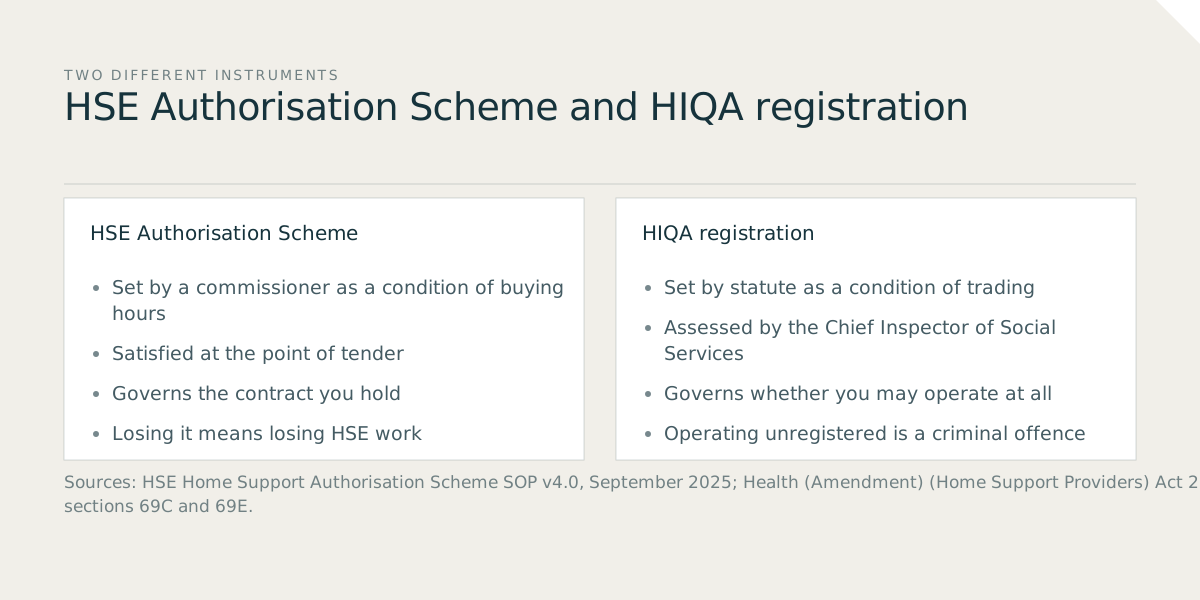
The HSE Authorisation Scheme and HIQA registration are not the same instrument, and satisfying one does not deliver the other. The Authorisation Scheme is a procurement condition that a commissioner sets before it buys hours from you. HIQA registration will be a statutory condition of trading, created by the Health (Amendment) (Home Support Providers) Act 2026, assessed against national standards and enforceable by criminal sanction.
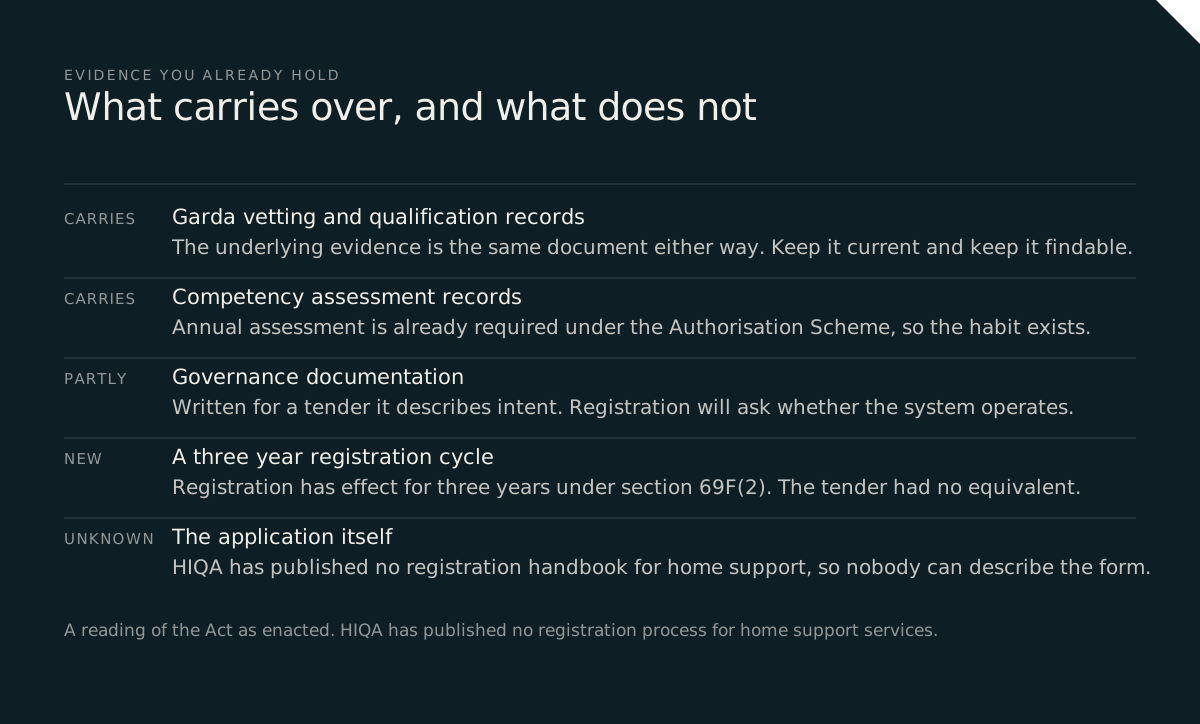
Some of what you already hold will transfer. Garda vetting records, qualification records, competency assessments and governance documentation are the same evidence whoever asks to see them. What changes is the purpose the evidence is put to, how often it is tested, and what follows when it is found wanting.
One caveat before anything else. HIQA has published no registration handbook for home support, so nobody can tell you precisely what HIQA registration will ask for. What can be set out is what the Act requires on its face, what the Authorisation Scheme already requires of you, and where the two do not meet.
On this page
What does the HSE Authorisation Scheme actually require?
The Authorisation Scheme sets out what a provider must hold before the HSE will place work with it. The operative document is the Home Support Services for Older People Authorisation Scheme Standard Operating Procedure, Version 4.0, published in September 2025, and its requirements are specific rather than aspirational.
- A QQI Level 5 major award, with the Care Skills and Care of the Older Person modules mandatory.
- A fully completed National Carer Competency Assessment at appointment and again annually.
- Garda vetting, or police clearance where that applies.
Those are firm requirements, and they are not trivial to evidence across a large roster of carers. What the Authorisation Scheme does not do is set an induction duration. It tells you what qualification a carer must hold and that their competence must be assessed each year, and it leaves the shape of induction to the provider.
That silence is reasonable for a purchaser. A commissioner is buying a service and checking that the people delivering it are qualified, assessed and vetted. HIQA registration will be asking a broader question, which is whether the service as a whole meets a published standard, and a folder of qualification records does not answer that on its own.
Is HIQA registration the same thing as being on an HSE approved provider list?
HIQA registration and a place on an HSE approved provider list are different things, granted by different bodies for different reasons. A place on an approved provider list is a commissioning arrangement: a purchaser has agreed to buy home support hours from you on agreed terms. HIQA registration will be statutory permission to carry on the business at all.
Section 69C of the Act as enacted provides that a person shall not carry on the business of a home support provider unless registered. The Act inserts a new Part 8A into the Health Act 2007, and enforcement sits with HIQA through the Chief Inspector of Social Services. Operating unregistered is a criminal offence.
The confusion is understandable. HSE approved provider lists are regional, and providers commonly appear on more than one, so an organisation can hold several places across several regions and reasonably feel well established. None of those places amounts to HIQA registration, because the lists answer a purchasing question and HIQA registration answers a regulatory one.

What transfers from the HSE tender to HIQA registration?
A good deal of the underlying evidence transfers, because the facts it records do not change with the audience. A QQI Level 5 award is the same award whether a commissioner or the Chief Inspector of Social Services is reading the file.
The material most likely to carry across into HIQA registration is the material you already keep for the Authorisation Scheme:
- Garda vetting and police clearance records, and the system that keeps them current.
- Qualification records, including the Care Skills and Care of the Older Person modules.
- Completed National Carer Competency Assessments, at appointment and annually.
- Governance documentation: written policies, reporting structures and lines of accountability.
- The organisational habit of assembling all of that for an external reader on request.
The last item is the one providers undervalue. Organisations told HIQA during its stakeholder work on the draft standards that they had been through the exercise repeatedly: “we’ve been doing it all along… it’s all there you know and we’ve had to kind of prove this every time… under the tendering process we would have had to put forward all of our governance and structures and what’s in place.” That experience counts for something.
What it does not do is finish the job. HIQA registration will ask for many of the same documents in service of a different question, and evidence assembled to satisfy a tender is usually organised around the tender rather than around the person receiving care.
What does HIQA registration ask for that the Authorisation Scheme never did?
HIQA registration will test the service against national standards rather than against a purchaser’s contract terms. The draft National Standards for Home Support Services are written in the first person from the service user’s point of view, and each standard carries a corresponding requirement on the provider.
There are four principles and thirteen standards in the draft: a Human Rights-based Approach with four standards, Safety and Wellbeing with five, Responsiveness with three, and Accountability with one. The distribution says something on its own. Safety and Wellbeing carries the largest group, and the human rights principle comes first rather than last.
There is also a scope difference that is easy to miss. The Authorisation Scheme concerns home support for older people. The Act defines a home support service as support provided to a service user by reason of illness, frailty or disability, in relation to activities of daily living, instrumental activities of daily living or other activities, and primarily provided in the service user’s private dwelling. That definition is not age-limited, so work sitting entirely outside the Authorisation Scheme can still sit inside the registration requirement.
| Question | HSE Authorisation Scheme | HIQA registration |
|---|---|---|
| Purpose | A condition of purchase, set before public money is spent | A statutory condition of carrying on the business |
| Who sets it | The HSE, acting as commissioner | The Oireachtas, enforced by HIQA through the Chief Inspector of Social Services |
| What it governs | The terms on which the HSE buys home support hours for older people | The provision of a home support service as defined in the Act, whoever pays for it |
| Duration | As long as the commissioning arrangement runs | Three years, under section 69F(2) |
| Consequence of failure | Loss of, or exclusion from, a place on an approved provider list | Operating unregistered is a criminal offence |
The table makes one point worth stating plainly. HIQA registration is not a senior version of the Authorisation Scheme. It is a separate instrument with a different author, a different subject and a different sanction, and an organisation can be in good standing with every commissioner it deals with and still hold no HIQA registration at all.
When do the notification and application clocks start?
Both transitional clocks run from the commencement of section 69C specifically, not from the commencement of the Act as a whole. Section 1(2) allows the Minister to commence different provisions on different days, so those two moments are not necessarily the same.
Section 69ZD(2) requires an existing provider to notify the chief inspector no later than three months after the date on which section 69C comes into operation. Section 69ZD(3) requires an application for registration no later than two years after that same date. Most published commentary simplifies this and gets it wrong, usually by attaching both deadlines to commencement of the Act generally.
Section 69ZD(1) allows an existing provider to keep providing the service while the chief inspector considers its application, conditional on having complied with both of those requirements. The protection that keeps you trading is therefore tied to a notification you may not have made yet.
Sections 69ZD(4) and (5) require the chief inspector to establish and maintain a register of providers who have notified, and to make it available on the internet. That is a publicly accessible transitional register, readable by families, commissioners and competitors alike, and your presence on it will be public long before HIQA registration is decided either way.
No commencement order has been made, and the timing is not yet known. At Committee Stage the Minister of State said that a commencement period of up to twelve months was envisaged, to allow ministerial regulations, HIQA national standards and guidance to be developed, as reported by William Fry in July 2026. That is an intention stated in the House rather than a date. The structure of the Act is set out in more detail in our guide to the Act.
What if you take no HSE work at all?
Private-pay providers have never been through the Authorisation Scheme, and they start from a different place, yet HIQA registration will apply to them in the same terms. Section 69C does not distinguish between publicly funded and privately funded work: it addresses carrying on the business of a home support provider, whoever is paying.
The gap is not necessarily one of quality. A private provider may run a careful service with good carers and satisfied families. The gap is one of external testing: no commissioner has examined the files, no contract has imposed a qualification baseline, and no outside reader has tried to follow the records without help from the person who wrote them.
For those organisations, HIQA registration will be the first external assessment of the service in its history. Providers coming from the Authorisation Scheme have at least rehearsed a version of the experience. Providers who have not should assume that preparation takes longer rather than less time, because the work begins with deciding what the records ought to look like.

How long does HIQA registration last, and what does that mean for planning?
Section 69F(2) provides that registration has effect for three years. HIQA registration is therefore not a document you obtain and file away: it is a state the organisation has to stay in for the length of the cycle and then demonstrate again.
That is a different rhythm from tendering. A tender has a submission date, and it is possible, if not advisable, to assemble the evidence in the weeks before it. A three-year registration is assessed on what the service was doing throughout, and records tidied for a single deadline tend to show their seams.
The annual National Carer Competency Assessment helps here, because it already gives the year a shape. A provider that treats it as a real review of practice, recorded at the time, generates exactly the continuous evidence a three-year cycle rewards. A provider that treats it as an annual signature generates paper.
Planning for HIQA registration therefore means planning for maintenance rather than for a submission: systems that produce evidence as a by-product of running the service, instead of a project that produces evidence once. Our compliance consultancy work is largely about that distinction.
What will HIQA registration cost?
Nobody can price HIQA registration yet, because no fees have been prescribed. Section 69E(2)(c) requires an application to be accompanied by the prescribed application fee, and section 99(3)(e) allows an annual fee to be prescribed, but the regulations that would set either figure do not exist.
Treat any figure you are quoted with suspicion. There is no published fee schedule for home support registration, and until regulations are made there cannot be one. Anyone offering a number is estimating a statutory fee before the statutory instrument that sets it has been written.
The fee is likely to be the smaller part of the cost in any case. Budgeting for HIQA registration means budgeting for time: the management hours spent mapping records, the training time, the supervision that has to be recorded properly rather than done informally, and the administrative work of bringing scattered files into one legible system. That cost is real whether or not a fee is ever set, and it is the part you can start reducing now.
What has HIQA published so far, and what is still missing?
HIQA published its draft National Standards for Home Support Services in November 2024 and consulted on them between 4 November and 13 December 2024. Those standards remain in draft as of September 2026, which means the benchmark against which HIQA registration will be assessed is not yet final.
What has not been published matters more for planning. There is no inspection framework for home support, no assessment judgment framework, no registration handbook and no fee schedule. HIQA’s published guidance for providers covers healthcare services, children’s services, disability services, older people’s services and International Protection Accommodation services. Home support is not among them.
That absence is why honest advice about HIQA registration has to be provisional in places. The Act is law and its requirements can be read today. The assessment apparatus around it is still being built, and anyone describing exactly how a home support inspection will run is describing something that has not been published.
Providers have made their own preference known. One told HIQA during its stakeholder work: “An initial review by HIQA which is focused on pointing out areas for improvement rather than purely a ‘compliance’, fail/pass review would help”. That work drew on focus groups with 51 home support providers and 80 organisational responses to the consultation, so it is a fair reflection of where the sector stands.
What can you do before the HIQA registration process exists?
You cannot complete an application that has not been published, but you can put the evidence into a state that an external reader can follow. Almost everything HIQA registration is likely to examine is already produced by the service, so the question is whether it can be found and whether it says what you assume it says.
- Put every carer file into the same shape: vetting, qualification, competency assessment, dates and who signed off.
- Record the annual competency assessment as an assessment of practice, with what was observed, rather than as a signature on a form.
- Write down who is accountable for what, and check that the chart matches how decisions are actually made.
- Read the draft standards from the service user’s side, since that is the voice they are written in.
- Find out what an outside reader makes of your records before one arrives with statutory powers.
The last point is the one providers postpone longest. A mock inspection is not a rehearsal of a published HIQA framework, because no such framework exists yet for home support. It is a test of whether the service can evidence what it says it does, and that part of HIQA registration will not change whatever shape the framework eventually takes.
There is a sequencing argument too. The work that takes longest is not paperwork; it is changing how supervision, training records and incident records are made in the first place. Start that while the timing is still unknown and HIQA registration becomes an assessment of a system that already works. Leave it, and it becomes a project competing with a three month notification clock.
CareReady is an Irish compliance and training consultancy working with private home support organisations. The work is preparation: getting records, governance and training evidence into a state that holds up when somebody outside the organisation reads them.
Sources: Health (Amendment) (Home Support Providers) Act 2026, as enacted · HSE Home Support Authorisation Scheme Standard Operating Procedure v4.0