

A signed attendance sheet proves that somebody was in the room. It does not prove that they can carry out the task safely, and at inspection those are two different questions.
The distinction sounds pedantic until you consider what it is protecting. Manual and people handling, for instance, is not knowledge that transfers by being explained. A care worker can listen attentively to a full session on safe transfers and still perform one badly, and the person who finds that out should not be the client.
Competency assessment is the step that closes that gap. Training delivers the content; competency assessment establishes that the individual can actually do it, observed, on the day, and records the outcome against their name.
On this page
What is the difference between training and competency assessment?
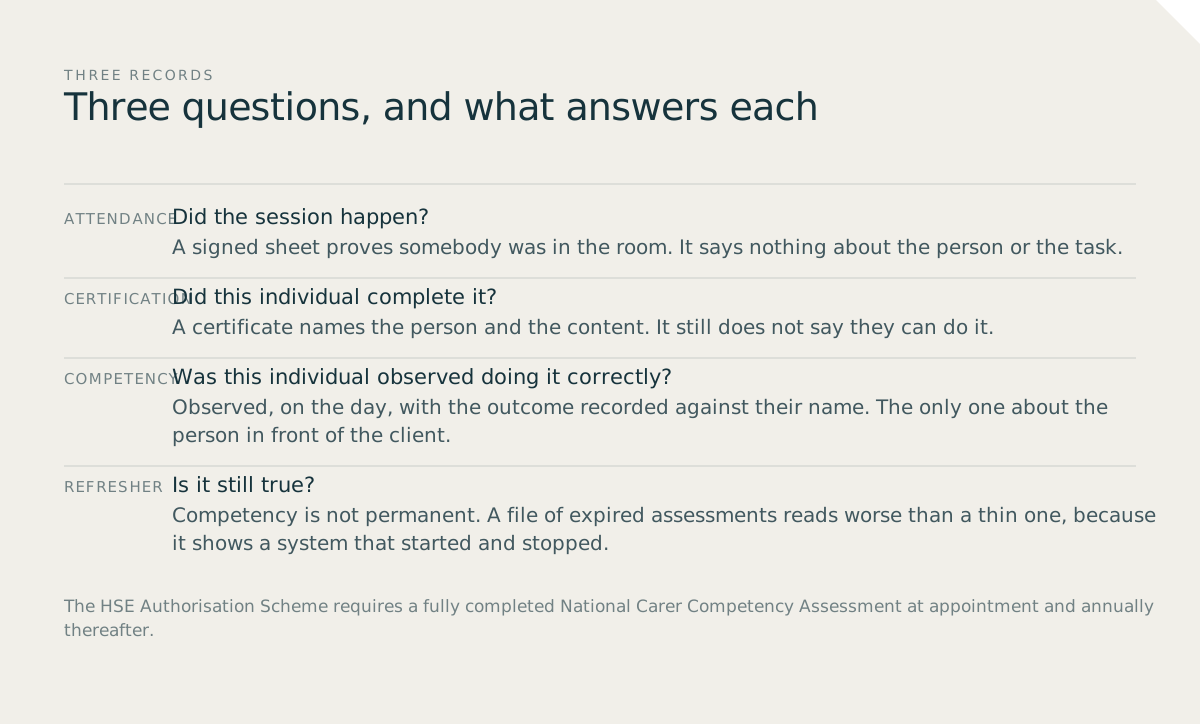
Training and competency assessment answer different questions about the same person. Training is a delivery event; competency assessment is a judgment about performance, made by somebody watching the work being done and written down afterwards.
- Attendance says the session happened.
- Certification says the individual completed it.
- Competency assessment says the individual was observed doing it correctly.
Only the third one is about the person in front of the client, and it is the one most commonly missing from a governance file. The first two are easy to collect and easy to report, which is part of why they accumulate while the third does not.
| Record | What it proves | What it does not prove |
|---|---|---|
| Attendance sheet | A session was delivered and a named person was present | That the person understood it or can perform the task |
| Certificate | A named person completed a course of training | That performance was ever observed in the work itself |
| Competency assessment | A named assessor observed the task performed correctly on a stated date | That competence persists indefinitely without reassessment |
Board reports are where the confusion usually shows. A service can report ninety per cent training compliance and hold almost no competency assessment records at all, and nothing in the first figure warns anybody about the second.
Is competency assessment already a requirement, or only a future one?
Annual competency assessment is a live requirement today for any provider taking HSE home support work. The Home Support Services for Older People Authorisation Scheme Standard Operating Procedure, Version 4.0 of September 2025, requires a fully completed National Carer Competency Assessment at appointment and again annually.
The same scheme requires a QQI Level 5 major award, with the Care Skills and Care of the Older Person modules mandatory, together with Garda vetting or police clearance where that applies. Those requirements are specific, and they are not difficult to state. They are difficult to evidence across a large roster.
That timing matters for how providers talk about this. Competency assessment is not a new obligation arriving with regulation at some future date; for a large part of the sector it is an existing procurement condition that falls due every year, and the annual cadence is the part most often allowed to slip.
One distinction is worth holding onto. The Authorisation Scheme is a procurement condition set by a commissioner, and a place on a regional list of approved providers is a commissioning arrangement rather than a statutory registration. Those lists are regional, providers commonly appear on more than one, and the underlying obligation does not multiply with them.

What do the draft national standards say about staff competence?
Standard 3.3 of the draft National Standards for Home Support Services addresses staff competence directly. The service user statement reads: “I receive care and support from skilled, experienced and trained staff who are clear about their role and responsibility in my care and are informed by the best available evidence and information and are supported to do their job well.”
The provider requirement attached to 3.3 is the operative half. A provider must have systems and structures to ensure staff have the skills, training and experience to deliver safe and effective care and support informed by the best available evidence, and must ensure staff are supported and supervised.
Read that requirement against a training log. A log of attendance evidences training and nothing else: it does not evidence skills, it does not evidence experience, and it is silent on supervision. Competency assessment and supervision records are what turn standard 3.3 from a claim into something an outside reader can check.
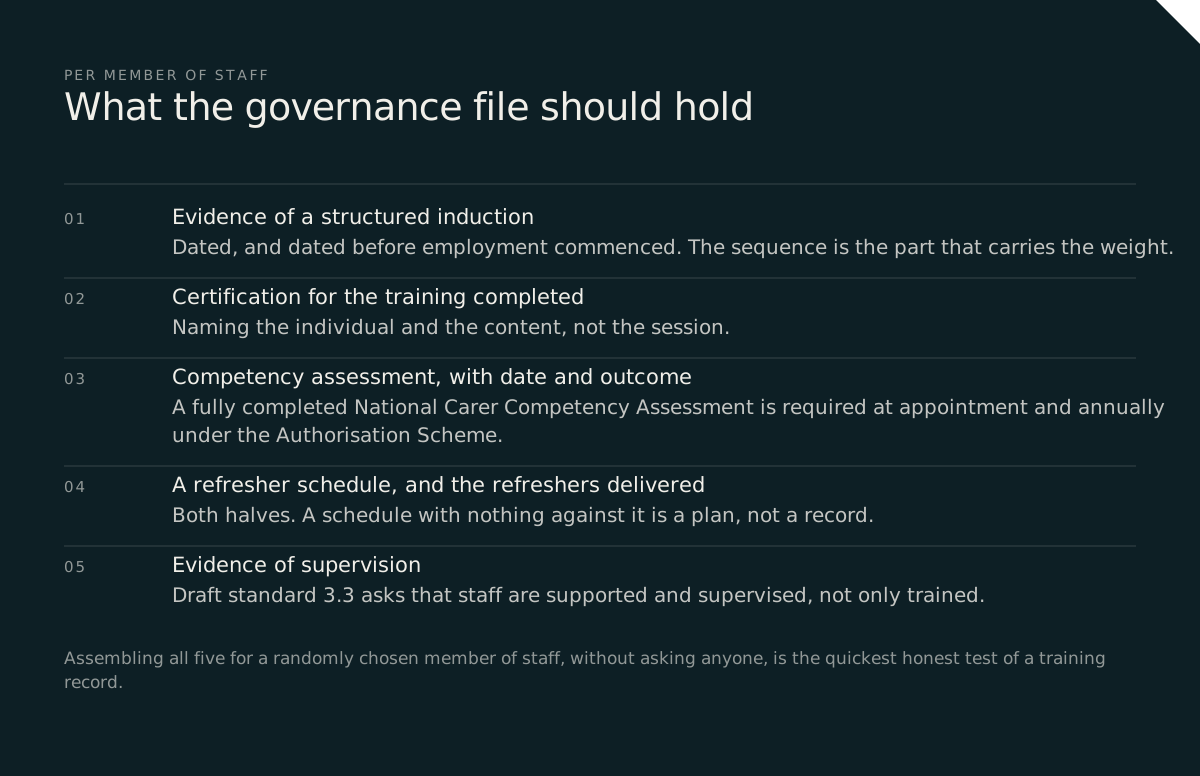
Supervision deserves its own line in the file. Standard 3.3 names support and supervision alongside skills, training and experience, so a provider that observes practice well but keeps no supervision record has met half of what the standard asks and can show only the half that was written down.
The standards remain in draft. Published in November 2024 with consultation running from 4 November to 13 December 2024, they were still draft as of September 2026, and HIQA has published no inspection framework for home support. Preparing against the draft is the best available option, and competency assessment is one of the areas least likely to change.
Where does competency assessment sit in safeguarding and risk?
Standard 2.4 requires a provider to identify aspects of delivery associated with possible increased risk of harm and to put measures in place to reduce those risks. Competency assessment is one of those measures, and it is one of the few that can be evidenced for a named person on a named date.
Standard 2.3 sits alongside it and requires arrangements to safeguard people from harm and abuse through consistent implementation of relevant national standards, legislation, regulation, national policy, procedures and guidance. Consistency is the word doing the work there, and consistency across a dispersed workforce is a competence question before it is a policy question.
A worked example makes the link concrete. A service user needs two carers and a hoist for transfers, the risk assessment names that as the control, and the control is only real if every carer rostered to that call has been assessed on that equipment. Without competency assessment records for those named carers, the control is a sentence in a document.
Providers themselves have raised a related concern. In HIQA’s stakeholder work, providers pointed to home support worker responsibilities for medication and nutritional assessment exceeding non-clinical training levels, which is precisely the territory where competency assessment stops being administrative and starts being a safety control.
What does the Act itself require on training?
The Act sets no training requirements directly. The Health (Amendment) (Home Support Providers) Act 2026 creates the registration duty, the transitional register and the enforcement powers, and leaves detailed requirements to ministerial regulations that do not yet exist.
Section 69C of the Act as enacted provides that a person shall not carry on the business of a home support provider unless registered. Existing providers must notify the chief inspector within three months of the commencement of section 69C and apply for registration within two years of that same date, and registration then has effect for three years.
Silence in the Act is not a reason to wait. A registration application describes how an organisation is governed, staffed, trained and evidenced, and competency assessment is the part of that description that cannot be produced at short notice. Reading what the Act actually requires is more useful than waiting for regulations to appear.
What should a competency assessment record contain?
A competency assessment record has to survive being read by a stranger. Six fields do most of that work, and a record missing any of them tends to read as an attendance note wearing a different heading.
- The name of the person assessed and the name of the assessor.
- The specific task assessed, described precisely rather than as a broad heading such as “moving and handling”.
- The date of the assessment.
- What was actually observed, in a sentence or two, rather than a tick.
- The outcome, competent or not yet competent, and what follows where the outcome is the second.
- The date the assessment falls due again.
The fourth field is the one that changes the character of the document. A tick box with a signature is not useless, but a short description of what was observed is what lets a reader six months later tell an assessment apart from a register of names.
The assessor field matters more than it looks. Record who assessed and what qualifies them to assess that task, because a competency assessment carried out by somebody with no standing to judge the work is evidence of an administrative process rather than of competence.
An outcome of not yet competent is worth recording openly rather than avoiding. A file that only ever records success is either describing a remarkable workforce or describing an assessment process that does not assess anything, and the second reading is the one an experienced reader reaches first.
What does the governance file need to hold for each member of staff?
Four items, held per named member of staff, cover most of what will be asked for. Each answers a different question, and each is independently checkable from the file itself.
- Evidence of a structured induction, dated before employment commenced.
- Certification for training completed.
- Competency assessment, with date and outcome.
- A refresher schedule, and the record of refreshers actually delivered.
Qualification and vetting records sit alongside those four for any provider inside the Authorisation Scheme, since the QQI Level 5 award and Garda vetting are checked there. Keeping all of it in one place per person is the difference between producing a file in two minutes and assembling one over an afternoon.
One trap is worth flagging while files are being rebuilt. The qualification requirements for a person in charge, meaning NFQ Level 8 or 9 plus three years of experience and effective from 31 March 2025, apply to designated centres for older people. They do not apply to home support services, and providers should not assume they transfer.
The fourth item is what separates a system from an episode. Induction, certification and a first assessment can all be completed in a new starter’s first month and then never revisited, which produces a tidy file and a stale one.

Why do expired assessments read worse than a thin file?
The refresher record is the quiet failure. Competency is not permanent.
A worker assessed as competent three years ago, on equipment the organisation no longer uses, is a record rather than an assurance, and a file full of expired assessments reads worse than a thin one, because it shows a system that was set up and then stopped.
Cadence solves most of this, and for a large part of the sector the cadence is already set. The Authorisation Scheme requires a completed National Carer Competency Assessment annually, which gives a default rhythm that a provider can build a calendar around rather than inventing one.
Events should trigger reassessment as well as the calendar. New equipment, a new clinical task, a change in a service user’s needs, a return from extended leave and any incident involving the task itself are all reasons to bring an assessment forward rather than waiting for the anniversary.
How do you assess a whole workforce without stopping the service?
Assessment happens on shift, not in a classroom, and that is what makes it plannable. Competency assessment carried out during real visits, with the service user’s consent, costs the roster very little and produces better evidence than a simulated exercise in an office.
- Build the register first: every named member of staff, every task that requires assessment, and the date each one is next due.
- Decide the assessor pool, and make sure the assessors have themselves been assessed on what they are judging.
- Batch by task rather than by person, so an assessor covers one task across several carers in a run of visits.
- Front load new starters and the highest risk tasks, and let lower risk areas follow.
- Track by date due rather than by percentage complete.
The last point is a small discipline with a large effect. Percentage complete is a comforting metric that hides the shape of the problem, because a service can be most of the way through its competency assessment programme and still have every overdue assessment sitting on its highest risk task.
Consent is the small practical point that catches providers out. Observing practice during a real visit puts a third person in somebody’s home, so the service user should be asked in advance and the request recorded, which is itself a piece of person-centred evidence rather than an obstacle to collecting it.
Assessor capacity is usually the constraint rather than carer availability. A provider that trains a small number of supervisors as assessors, and rosters their time deliberately, will get through a workforce far faster than one that treats assessment as an extra duty for whoever is free.
Why is competency assessment the longest lead time on a readiness list?
Competency assessment has the longest lead time of anything on a readiness list. Policies can be written in a week; assessing a workforce depends on rosters and on spreading assessments over a period, and there is no way to compress that which does not show in the record.
The arithmetic is unforgiving in a plain way. Every carer needs to be observed, by a credible assessor, on each task that matters, while the service continues to run, and the only variable a provider controls is when it starts.
There is a market argument too. The Department of Health’s Regulatory Impact Analysis estimated about 200 home support providers in Ireland and up to 29,000 home support workers across all sectors, cited in the Oireachtas Bill Digest of 9 February 2026, and those providers will be working to the same regulatory timetable.
Demand for assessor time, training delivery and external review will concentrate into the same window. A provider that begins its programme early buys it in an ordinary market; one that begins late buys it in a queue.
What does competency assessment actually buy you?
Competency assessment buys certainty about the people doing the work. Everything else in a training file describes an input; competency assessment is the only record that describes an outcome for a named individual on a named date.
Put plainly, it is the difference between recording that training was provided and knowing that it worked.
The regulatory benefit follows from that rather than leading it. A provider that can produce a current competency assessment for every carer on every task that carries risk has answered the staffing half of standard 3.3, a good part of 2.4, and the annual requirement the Authorisation Scheme already imposes, with one body of evidence.
The operational benefit is quieter and arrives sooner. Assessment surfaces the carer who has been quietly avoiding a piece of equipment, the technique that drifted after a supervisor left, and the task that everybody assumed somebody else had covered, all of which are cheaper to find through a planned programme than through an incident.
CareReady is an Irish compliance and training consultancy working with private home support organisations. The work is preparation: getting governance, training records and competency evidence into a state that holds up when somebody outside the organisation reads them.
Sources: HSE Home Support Authorisation Scheme Standard Operating Procedure v4.0 · HIQA Draft National Standards for Home Support Services