

The care staff training a home support provider must hold today comes from one document, and it is not a HIQA document. It is the HSE’s Home Support Services for Older People Authorisation Scheme Standard Operating Procedure, Version 4.0, published in September 2025, and it is a purchasing condition rather than a statute.
The Health (Amendment) (Home Support Providers) Act 2026 sets no care staff training requirements of its own. It empowers the Minister to make regulations, and those regulations have not been made, so anyone describing what the Act demands of your training file is describing something that does not exist yet.
What follows covers the care staff training the published requirements actually name, what HIQA’s draft standards add, one widely held assumption that is wrong, and the records that turn training from an activity into evidence somebody else can read.
On this page
What care staff training is actually required today?
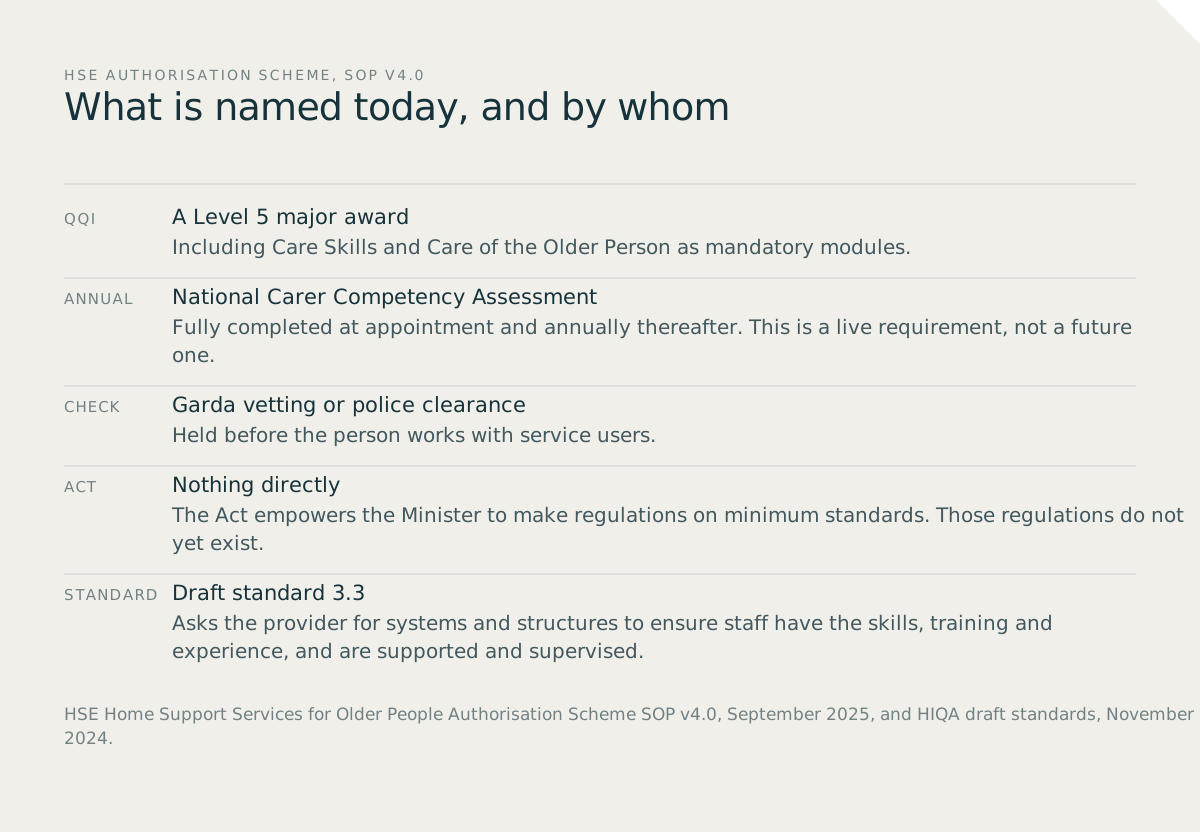
The care staff training required today is set by the HSE Authorisation Scheme, and it names three things. All three attach to the individual carer rather than to the organisation.
- A QQI Level 5 major award, with the Care Skills and Care of the Older Person modules mandatory.
- A fully completed National Carer Competency Assessment at appointment and again annually.
- Garda vetting, or police clearance where that applies.
Those three come from the Authorisation Scheme Standard Operating Procedure, Version 4.0. The list is short, and its brevity gets misread as leniency. Evidencing a QQI Level 5 major award for every carer on a roster, with the two named modules visible on each transcript, is not a small piece of administration.
Note what the requirement is attached to. Two of the three are qualifications and checks on the individual, held once. The third, competency assessment, recurs, and recurring obligations are the ones that quietly lapse.
One scoping point is often missed. The Authorisation Scheme binds you where you hold HSE work, because it is the condition a commissioner attaches to buying hours, so a provider serving only private clients sits outside it today. Registration under the Act will not work that way: the prohibition attaches to carrying on the business of a home support provider, subject to the exclusions in section 69B(2), whoever is paying. The scheme is a floor for staff training arrangements rather than a ceiling.
Does the Act set care staff training requirements?
The Act sets no care staff training requirements directly. The registration system it creates is the substance: section 69C provides that a person shall not carry on the business of a home support provider unless registered, enforcement sits with HIQA through the Chief Inspector of Social Services, and operating unregistered is a criminal offence.
Care staff training requirements, when they come, will come from regulations. The Act empowers the Minister to make them, and none have been made. The Health (Amendment) (Home Support Providers) Act 2026 was enacted on 1 July 2026 and has not been commenced, and the timing of commencement is not yet known.
That leaves a provider with two live sources of obligation and one future one. The Authorisation Scheme, which applies now if you hold HSE work. The draft standards, which apply to nobody yet. And regulations, which do not exist and cannot be prepared for in detail.
How much sits in those regulations is easy to underestimate. No fees have been prescribed either, although the Act provides for an application fee and allows an annual fee to be set, so even the cost of registering is unknown at present. Any care staff training requirement the Minister decides to impose will arrive by the same route, and not before.

Does the Authorisation Scheme make care staff training a statutory requirement?
The Authorisation Scheme is a procurement condition, not a statutory registration. The HSE sets it as a purchaser deciding whose hours it will buy, so the consequence of failing it is commercial: work stops coming, or it stops being placed with you.
Being on an HSE approved provider list is a commissioning arrangement and nothing more. Those lists are regional, and providers commonly appear on more than one, which means the same care staff training records get presented to several audiences who are all asking the same questions in slightly different formats.
Registration under the Act will be a different instrument with a different consequence. A purchaser can decline to buy from you. A regulator can stop you trading, and trading unregistered is an offence, which is the practical reason the two should not be treated as interchangeable.
There is a record keeping consequence to that difference. Because the Authorisation Scheme is a purchasing condition, its care staff training requirements can be revised by the purchaser, as the existence of a version 4.0 demonstrates. Records built narrowly to satisfy one version of one scheme tend not to survive the next, and they certainly do not transfer intact to a statutory process nobody has published yet.
What do the draft standards say about care staff training?
Draft standard 3.3 is the one that addresses care staff training directly. The provider requirement is systems and structures to ensure staff have the skills, training and experience to deliver safe and effective care and support informed by the best available evidence, and to ensure staff are supported and supervised.
Three phrases in that sentence do real work. “Systems and structures” is not the same as a list of courses. “Informed by the best available evidence” implies that content is reviewed rather than inherited. “Supported and supervised” is a separate obligation from care staff training altogether, and it is the one providers most often have no record of.
The caution that matters here: these are drafts. HIQA published the draft standards in November 2024, the consultation ran from 4 November to 13 December 2024, and they remain draft. Standard 3.3 is a reasonable guide to the direction of travel and not a current requirement.
Standard 3.3 also implies something about who decides. Systems and structures suggest the provider works out which skills the service actually needs, then closes the gap, which is a different activity from buying a fixed annual package of care staff training and treating the invoice as the evidence.
Where do safeguarding and risk fit into care staff training?
Draft standards 2.3 and 2.4 bear on care staff training without naming it. Standard 2.3 asks for arrangements to safeguard people from harm and abuse through consistent implementation of relevant legislation, national policy, procedures and guidance, and 2.4 asks for arrangements to identify aspects of delivery associated with a possible increased risk of harm, with measures to reduce those risks.
Both are delivered by carers in somebody’s home, usually alone. Consistent implementation of a safeguarding policy depends on every worker recognising a concern and knowing what to do with it, and a risk control measure only reduces risk if the person at the visit carries it out. On a plain reading, that puts both standards inside the care staff training question rather than beside it.
Providers made a related point to HIQA during the consultation: that home support worker responsibilities for medication and nutritional assessment could exceed non-clinical training levels. That is a care staff training issue and a role boundary issue at the same time, and the written boundary is as important as the course.
Draft standard 2.5 points the same way. Responding to an incident in a timely manner, and being open with the person about what happened, depends first on the carer at the visit recognising the event and reporting it, which is a training question before it becomes a governance one.
Do the person in charge qualification rules apply to home support?
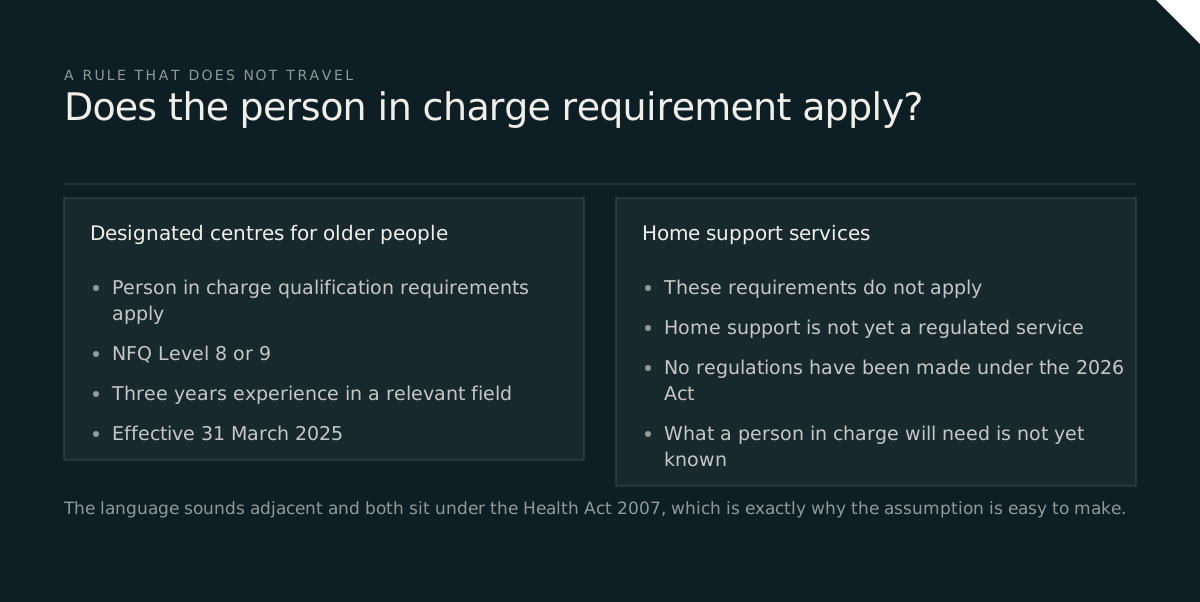
The person in charge qualification rules do not apply to home support services. NFQ Level 8 or 9 plus three years’ experience, effective from 31 March 2025, applies to designated centres for older people, and a home support service is not a designated centre.
The assumption that the rules transfer is easy to understand. Both regimes sit under the Health Act 2007, the Act inserts a new Part 8A into that same statute, the regulator is the same, and the vocabulary of registration and persons in charge sounds adjacent. Adjacent is not the same as applicable.
What will be required of a person in charge in home support is genuinely unknown, because the regulations that would set it have not been made. Anybody who tells you the Level 8 threshold is coming to home support is predicting, and a recruitment or promotion decision made on that prediction is a decision made on nothing.
The reasonable position sits between the two errors. Do not recruit to a standard that has not been set, and do not assume nothing will be set, which means keeping a clear record of the qualifications and experience your management team actually holds.
It is worth being precise about who the Act addresses. Section 69C provides that a person shall not carry on the business of a home support provider unless registered, so the duty falls on the business. What will be asked of named individuals inside it, including anyone described as a person in charge, is a matter for regulations that have not been made.

What is the difference between attendance, certification and competency?
Attendance, certification and competency are three different records answering three different questions. A signed attendance sheet proves somebody was in the room, a certificate proves an awarding body assessed them against its own criteria, and a competency assessment proves a named assessor watched this person perform the task and judged them able to do it safely.
- Attendance: was this person present, on what date, for what content?
- Certification: did an awarding body assess and certify them, and is the certificate still within whatever validity period it states?
- Competency: can this person do the task in practice, as judged by somebody who watched them do it?
The distinction sounds pedantic until you consider what it protects. Moving and people handling is the obvious case: it is not knowledge that transfers by being explained, and an attendance record against it answers a question nobody is really asking.
A care staff training file that holds only the first of the three is thinner than it looks. It can show effort and cannot show capability, and those are separate claims.
The three also fail in different ways. Attendance can be complete and meaningless, certification can be valid and unrelated to the task the person actually performs, and competency can be real but undocumented. Reading a care staff training file properly means working out which of the three is missing, rather than counting pages.
How often does competency have to be reassessed?
Annually, under the HSE Authorisation Scheme. The National Carer Competency Assessment must be fully completed at appointment and again each year, which makes it the only recurring care staff training obligation currently written down for home support providers.
The words “fully completed” are worth dwelling on. A partially completed assessment, with sections left blank because the assessor ran out of time or the carer was not observed doing everything, does not meet the requirement, and it is a common finding when files are read properly rather than counted.
There is also a presentation point that operators underrate. A file of expired competency assessments reads worse than a thin one, because it shows a system that started and stopped, and a reader who sees a process abandoned will wonder what else was abandoned.
A second timing question has no published answer at all. Nothing in the published requirements sets a repeat interval for care staff training beyond the annual competency assessment, so the provider decides what gets refreshed and when. A documented interval that you apply consistently is defensible. Silence is harder to defend, because it looks the same as neglect.
What care staff training records should a provider be able to produce?
A provider should be able to produce a complete care staff training record for any named member of staff, on request, without assembling it first. The table below sets out what that file usually contains, what each item demonstrates, and how often it needs attention.
| Record | What it demonstrates | How often it needs refreshing |
|---|---|---|
| QQI Level 5 major award, showing Care Skills and Care of the Older Person | The worker holds the qualification the Authorisation Scheme requires | Once, verified at appointment and retained |
| National Carer Competency Assessment, fully completed | Competence was assessed against defined tasks, not simply taught | At appointment and annually |
| Garda vetting or police clearance | The vetting check was completed before the worker attended a client | From appointment, then in line with your own vetting policy |
| Attendance records for each session | Who was present, on what date, for what content | Per session, retained |
| Certificates for specific care staff training | An awarding body assessed and certified the worker | Whatever validity period the certificate itself states |
| Supervision notes | The worker is supported and supervised, as draft standard 3.3 puts it | No published frequency exists; set one and keep to it |
Two of those rows are not required by anything published today. Supervision notes and per-session attendance are included because they answer questions the other records cannot, and because a care staff training file assembled only from mandatory items tends to read as a compliance exercise rather than a system.
Hold the record per person, not per course. A course list tells you how many people attended something. A staff file tells you whether a named carer, the one who will be in a named client’s home on Thursday morning, is qualified, assessed, vetted and supervised, and that is the question a reviewer asks.
Apply one test to the whole file. Could a person who does not work in your organisation pick it up and follow it, without a phone call to the person who built it? Records that fail that test are the most common weakness in care staff training documentation and among the cheapest to fix.
What care staff training is worth putting in place before the regulations?
Build the things that will be needed under any version of the rules. Qualification verification, annual competency assessment, safeguarding capability and a supervision pattern are not contingent on the wording of regulations nobody has drafted, which makes them the safe places to spend effort now.
- Verify, rather than assume, that every carer’s QQI Level 5 award shows both named modules, and record where the evidence is held.
- Put the annual competency cycle on a calendar with a named owner, so it does not depend on somebody remembering.
- Write down the role boundary: what a home support worker does, and what is referred on.
- Record supervision as it happens. Reconstructing a year of it later is both painful and unconvincing.
- Read one full staff file cold, as a stranger would, and fix what you cannot follow.
Two things are not worth doing yet. Rewriting policies to match draft wording that may still change, and buying training against a person in charge standard that has not been set for home support.
None of that requires knowing what the regulations will say. It is the same care staff training infrastructure that the Authorisation Scheme already assumes and that draft standard 3.3 describes, which is a reasonable indication that it will survive whatever wording arrives.
Some providers test the result themselves by pulling files at random. Others prefer an outside reader, which is the whole point of a mock inspection: a person who did not build the system is better at noticing what is missing from it.
One closing caution. Nothing above should be read as a forecast of what the regulations will require, because they have not been made, and the draft standards quoted are still drafts. What can be said is that care staff training which is qualified, assessed, supervised and recorded is defensible under the requirements that exist today, which is the only test currently available.
CareReady is an Irish compliance and training consultancy working with private home support providers. The work is preparation: reading a service’s records the way an outside reader will, and closing the distance between what an organisation does and what it can show.
Sources: HSE Home Support Authorisation Scheme Standard Operating Procedure v4.0 · HIQA Draft National Standards for Home Support Services