

HIQA’s draft national standards for home support services are written from the point of view of the person receiving the service. Each of the thirteen opens in the first person, with a sentence like “My human rights are explained to me in a way that I can understand.” That is a promise made to a person, which is the main reason providers struggle to turn the national standards into a task list.
Each standard also carries a second half: a provider requirement, phrased as something the organisation must have arrangements for. That half has had far less attention, and it is the one you can act on. What follows takes all thirteen, principle by principle: what the person is promised, what the provider must have arrangements for, and what evidence would demonstrate it.
One caution before any of it. The national standards discussed here are drafts. HIQA published them in November 2024, the consultation ran from 4 November to 13 December 2024, and they remain draft as of September 2026. Nothing below describes a settled requirement, and the evidence column is a reasonable reading, not a statement of what HIQA will ask to see.
On this page
What are the national standards for home support?
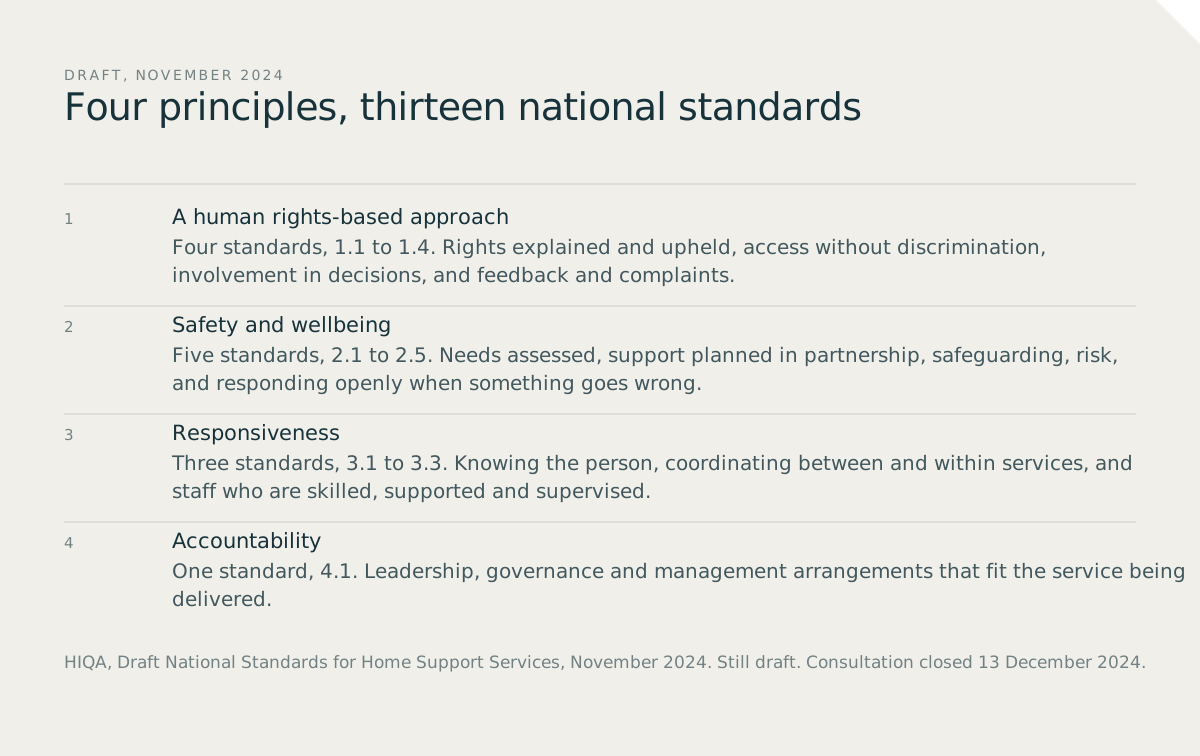
The national standards for home support are HIQA’s Draft National Standards for Home Support Services, published in November 2024. They contain thirteen standards grouped under four principles: a human rights-based approach, safety and wellbeing, responsiveness, and accountability.
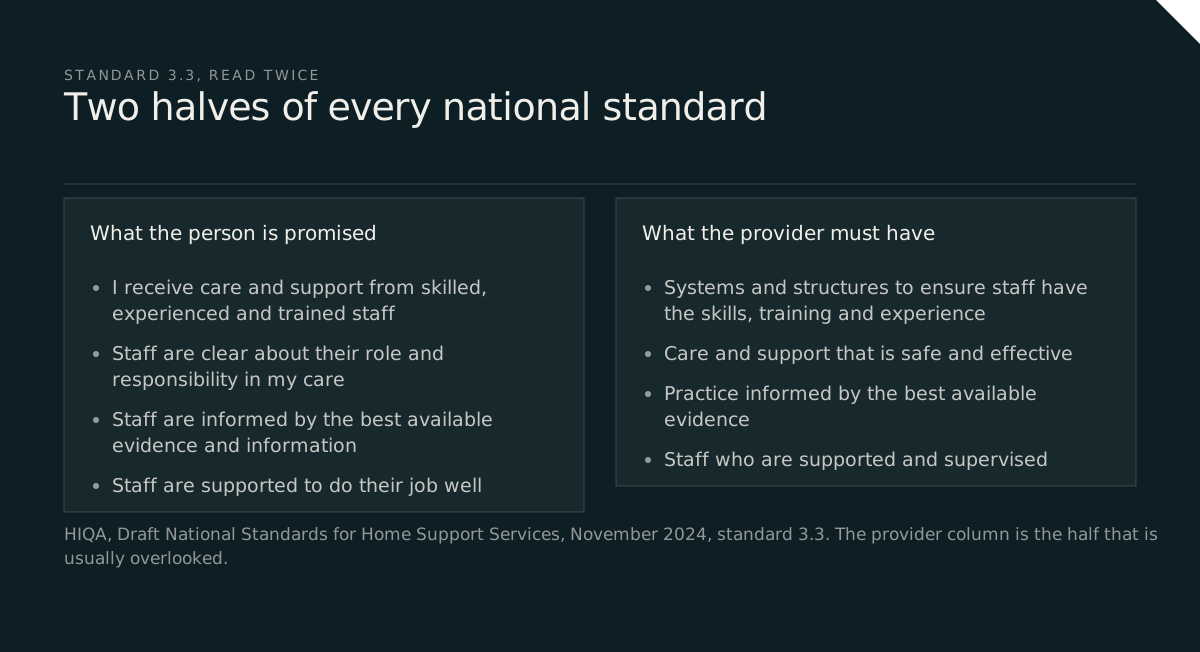
Every one of the thirteen has the same two-part shape. First a statement in the service user’s voice, describing what the person should be able to say about their service. Then a provider requirement, phrased as arrangements in place to deliver what the person has just described.
| Principle | Standards | How many | Subject matter |
|---|---|---|---|
| 1. A human rights-based approach | 1.1 to 1.4 | 4 | Rights, information, decision-making, feedback and complaints |
| 2. Safety and wellbeing | 2.1 to 2.5 | 5 | Assessment, care planning, safeguarding, risk, incidents and open disclosure |
| 3. Responsiveness | 3.1 to 3.3 | 3 | Knowing the person, coordination, staff skills and supervision |
| 4. Accountability | 4.1 | 1 | Leadership, governance and management |
Safety and wellbeing carries five of the thirteen national standards, more than any other principle. Accountability carries one, and it sits underneath the other twelve.
Why are the national standards so hard to act on?
The national standards are hard to act on because the half that gets quoted describes an experience rather than an instruction. “I am supported to be involved in planning and making decisions about my home support” is how a person should be able to describe their service. It is not a policy, a form or a file.
The provider requirement underneath is more tractable, though still pitched at the level of arrangements rather than artefacts. HIQA asks for arrangements to be in place. It does not say what they look like on paper, how often they are reviewed, or what a reader coming cold to the file should find.
That third question has no published answer. HIQA has produced no inspection framework for home support, no assessment judgment framework, no registration handbook and no fee schedule, and its provider guidance covers healthcare, children’s, disability, older people’s and International Protection Accommodation services, not home support.
The evidence set out against each of the national standards below is therefore a reading of the provider requirement, nothing more. One provider told HIQA: “we’ve been doing it all along… it’s all there you know and we’ve had to kind of prove this every time.” The work is rarely absent; the record that lets somebody else see it often is.

Principle 1: a human rights-based approach (standards 1.1 to 1.4)
Principle 1 holds four of the thirteen national standards, covering rights, information, decision-making and feedback. Together these four national standards ask whether the person knows what they are entitled to, understands what the service does, has a genuine say in it, and can raise a concern.
Standard 1.1: human rights, explained and upheld
What the person is promised: “My human rights are explained to me in a way that I can understand and are respected and upheld. I feel valued by the staff… and treated with dignity, compassion and respect.”
What the provider must have: arrangements to ensure a person’s human rights are explained to them in a way they can understand, and are protected, promoted and upheld.
What would demonstrate it: this would ordinarily mean holding the material you use to explain rights, in a form somebody with a sensory or cognitive impairment could follow, and a record that the explanation happened, with whom and when. A rights statement in a handbook evidences a publication, not a conversation.
Standard 1.2: information about the service, and access without discrimination
What the person is promised: “I understand what the home support service offers and how to access the service. I can access these services without experiencing any form of discrimination.”
What the provider must have: clear and accessible information about what the service does and how to access it, and assurance that people can do so without discrimination.
What would demonstrate it: current service information in plain language, dated so a reader can see it is not three years old, and a written basis on which packages are accepted or declined. The evidence that speaks to the second half is a decision trail showing refusals rested on capacity or clinical need.
Standard 1.3: involvement in planning and decisions
What the person is promised: “I am supported to be involved in planning and making decisions about my home support.”
What the provider must have: arrangements to ensure a person is supported to participate and make decisions about their home support, and has the relevant information they need to do so.
What would demonstrate it: support plans that record the person’s own words and choices, evidence that information was given before a decision rather than after, and a note of who was present. A plan signed by a coordinator and never discussed with the person is thin evidence here.
Standard 1.4: feedback, concerns and complaints
What the person is promised: “I have regular opportunities to give feedback… My feedback, concerns, complaints or compliments are listened to, recorded, and managed in a timely way.”
What the provider must have: arrangements that facilitate and support people to give feedback and raise concerns, manage and respond to them in a timely way, and communicate those arrangements clearly and accessibly.
What would demonstrate it: a log showing date received, date acknowledged, date responded and outcome, plus evidence that people were told the route exists. Providers told HIQA in its stakeholder involvement report that they wanted “a form or a route… that’s standardised across all agencies.” No standard route exists, so yours is the one to define and show.
Principle 2: safety and wellbeing (standards 2.1 to 2.5)
Principle 2 carries five of the thirteen national standards, covering assessment, care planning, safeguarding, risk and incidents. If the national standards have a centre of gravity it is here, and this is where the gap between doing the work and evidencing it is widest. Standards 2.1 and 2.2 concern the individual person; 2.3, 2.4 and 2.5 concern the system around them.
Standard 2.1: needs identified and assessed
What the person is promised: “My individual needs are identified and assessed… to maintain and optimise my overall health and wellbeing.”
What the provider must have: arrangements to ensure each individual’s needs are identified and assessed, and a discussion with the service user, and where applicable the HSE as commissioner, when reassessment is needed.
What would demonstrate it: a dated assessment for every person, a defined trigger for reassessment rather than an annual habit, and a record of the reassessment conversation. Providers told HIQA they often receive limited information when accepting a package, which makes the record of what you asked for as useful as what arrived.
Standard 2.2: planning care in partnership
What the person is promised: “My needs, strengths, preferences and goals are recognised as unique to me… I am treated as a partner when planning my care and support.”
What the provider must have: initial and ongoing planning and review of home support undertaken in partnership with the person, to develop and deliver their individual support plan.
What would demonstrate it: support plans showing a review history rather than a single creation date, goals in the person’s terms, and a visible link between a stated preference and what the roster does. On a plain reading, a plan that has never changed is evidence that nobody reviewed it.
Standard 2.3: safeguarding from harm and abuse
What the person is promised: “I am supported to be safe and live a whole and fulfilling life, free from harm or abuse.”
What the provider must have: arrangements to safeguard people from harm and abuse through consistent implementation of relevant national standards, legislation, regulation, national policy, procedures and guidance, and to work with other services as appropriate.
What would demonstrate it: a safeguarding policy naming the national policy it follows rather than describing good intentions, training records for everyone who attends a home, a log of concerns with dates and outcomes, and evidence of referral to other services where relevant. The word “consistent” in the provider requirement is doing real work.
Standard 2.4: identifying and reducing risk
What the person is promised: “I receive safe home support services and potential risks to me in delivery of my home support are identified and reduced.”
What the provider must have: arrangements to identify aspects of delivery associated with a possible increased risk of harm, and measures put in place to reduce those risks.
What would demonstrate it: risk assessments specific to the dwelling and the task rather than a generic form repeated across a caseload, a review date on each, and evidence that identified risks produced a change. The second half is most often unevidenced: the risk is named, and nothing shows what was done about it.
Standard 2.5: when something goes wrong
What the person is promised: “I am confident that if something goes wrong… my service will respond appropriately and in a timely manner… My service is open and honest with me throughout.”
What the provider must have: arrangements to identify, manage and report incidents in a timely manner in line with relevant national legislation, policy and guidance, use of the learning to inform future policy and practice, and support for people throughout, in line with the National Open Disclosure Policy and Frameworks.
What would demonstrate it: an incident record carrying the date of the event and of the response, so timeliness can be read off the page, a note of what was said to the person and by whom, and at least one instance where a policy changed because of an incident. That closed loop is the hardest item here to fake and the easiest to lose.

Principle 3: responsiveness (standards 3.1 to 3.3)
Principle 3 holds three of the thirteen national standards, all of them about continuity: familiar staff, working together, competent to do the job. These are the national standards most exposed to the constraints providers raised with HIQA, particularly short visit lengths and difficulty guaranteeing preferred times, and each asks for arrangements rather than a guaranteed outcome.
Standard 3.1: knowing the person
What the person is promised: “Staff take the time to get to know me as a person and understand my needs, preferences and goals… and respond in a timely and sensitive way.”
What the provider must have: arrangements to support staff to develop consistent and trusting relationships with service users, and to understand and respond to their needs, preferences and abilities.
What would demonstrate it: rostering data showing how many different workers attend one person over a period, the plainest measure of consistency available, plus a record of preferences carers can see before a visit. Consistency you achieve but cannot measure is hard to present to anybody.
Standard 3.2: coordination and working together
What the person is promised: “All staff involved in my care and support communicate and work together so that I receive the best possible care… at the right time.”
What the provider must have: arrangements to ensure care and support is coordinated effectively, and services that proactively work together to provide continuity of care.
What would demonstrate it: handover records, a written escalation route with names rather than job titles alone, and evidence of contact with other services about a shared client. Providers raised data protection interpretation as a barrier to information sharing, and the national standards do not resolve that for you, so a written position on what may be shared, and on what basis, is the evidence here.
Standard 3.3: skilled, trained and supervised staff
What the person is promised: “I receive care and support from skilled, experienced and trained staff who are clear about their role… and are supported to do their job well.”
What the provider must have: systems and structures to ensure staff have the skills, training and experience to deliver safe and effective care and support informed by the best available evidence, and staff who are supported and supervised.
What would demonstrate it: qualification records, competency assessment rather than attendance alone, and supervision notes that follow a pattern rather than arriving in a burst. Providers flagged role boundaries, where responsibilities for medication and nutritional assessment ran ahead of non-clinical staff training levels, and a written boundary is itself evidence under these national standards.
Principle 4: accountability (standard 4.1)
Principle 4 contains one standard, and it governs the other twelve. Leadership, governance and management arrangements are what turn the rest of the national standards from things that happened once into things done reliably, which is why this standard gets tested indirectly, by noticing whether the other twelve produce consistent records across clients, carers and months.
Standard 4.1: leadership, governance and management
What the person is promised: “I am confident that the service providing my home support is well managed and follows relevant policies and procedures to make sure I get the right care.”
What the provider must have: effective leadership, governance and management arrangements that reflect the type of home support service being delivered, including compliance with relevant legislation, national standards and policies.
What would demonstrate it: a written structure with named people and defined responsibilities, a schedule of what is reviewed, by whom and how often, notes showing those reviews happened, and a policy register carrying review dates. That last item is unglamorous and tells a reader more about governance than most of the rest.
What do the national standards not tell you?
The national standards do not tell you how compliance with them will be judged. The standards describe what good looks like from the service user’s chair, and what the provider must have arrangements for, then stop. Four things in particular are still open.
- How compliance will be assessed. There is no published judgment framework for home support, so no scale, thresholds or definitions of a finding.
- What an inspector will ask to see. No registration handbook exists, so the documentary expectations behind each standard are unstated.
- How the national standards will connect to registration under the Health (Amendment) (Home Support Providers) Act 2026, which is enacted but not commenced and whose regulations have not been made.
- Whether the thirteen survive consultation unchanged. Eighty organisational responses went in, and no final set has been published.
That is a genuine gap, and worth being honest about. What it does not justify is inaction, because none of those open questions changes whether the arrangements behind the national standards exist in your organisation today.
What should a provider do with draft national standards?
Build the arrangements, not the binder. Draft national standards are a reliable guide to the substance a regulator expects and an unreliable guide to final wording, so real arrangements will hold while documents formatted to a draft may need redoing.
Worth repeating, because the point is easy to lose in a long article. These national standards are drafts, published in November 2024, with the consultation closed on 13 December 2024 and no final version since. Treating a draft as settled overstates what is required today and risks effort that has to be undone. A workable sequence looks like this.
- Take the thirteen provider requirements in turn and ask the first question only: does this arrangement exist at all?
- Where it exists, ask whether somebody who did not write it could follow the record unaided.
- Where it does not, build the arrangement before writing the document about it. A policy describing a practice you do not have is worse than no policy.
- Repeat on a cycle rather than once, because the national standards will be finalised and your evidence has to survive that change.
The exercise is deliberately blunt. It needs no inspection framework, fee schedule or commencement date, none of which exist, and it produces a list that is useful whatever the final national standards say. Some organisations run it internally; others prefer an outside reader, on the ground that a person who did not write the records is better at seeing what is missing, which is the basis of compliance consultancy work.
One closing caution, the same one this article opened with. Everything above reads a draft, and the evidence suggested against each standard is a reasoned view of what the provider requirement implies, not a HIQA requirement. The thirteen provider requirements are the stable part. Read those, and the national standards become questions about your own arrangements rather than somebody else’s expectations.
CareReady is an Irish compliance and training consultancy working with private home support providers. The work is preparation: reading a service’s records the way an outside reader will, and closing the distance between what an organisation does and what it can show.
Sources: HIQA Draft National Standards for Home Support Services · HIQA Home Support Standards Stakeholder Involvement Report, November 2025