

The most common question in Irish home support at the moment is when home support regulation starts. Nobody can answer it. No commencement order has been made under the Health (Amendment) (Home Support Providers) Act 2026, and until one is made there is no date to give. The date is not being withheld. It has not been set.
A more useful question is what happens once it does start, and in what order. Home support regulation arrives as a sequence of statutory deadlines rather than as a single event, and that sequence is already written down in the Act. The first three months carry one obligation. The two years after that carry a much larger one.
What follows sets out the sequence, the two details in it that most published accounts of home support regulation get wrong or leave out entirely, and the preparation that is worth doing while the timing is still unknown. This is a description of what the Act says. It is not legal advice.
On this page
When does home support regulation actually start?
Home support regulation starts on the day a commencement order brings the relevant provisions of the Act into operation, and no such order has been made. The Act was enacted on 1 July 2026 as No. 17 of 2026 and inserts a new Part 8A into the Health Act 2007. Enactment and commencement are separate steps, and home support regulation begins at the second one.
Section 1(2) of the Act allows the Minister to appoint different days for different provisions. Home support regulation can therefore be switched on in pieces rather than all at once, which matters a great deal more than it sounds and is the subject of the third section below.
At Committee Stage the Minister of State said that a commencement period of up to twelve months was envisaged, to allow ministerial regulations, HIQA national standards and guidance to be developed. That was reported by William Fry on 20 July 2026. A stated expectation is not a commencement order, and it should not be converted into a date.
Anyone offering certainty about when home support regulation begins is guessing. The honest position is that the timing is not yet known. The useful position is to be ready for a date you will be told rather than a date you can predict, because the gap between those two is the whole planning problem.

What has to happen before home support regulation can commence?
Home support regulation needs machinery that does not yet exist, and building that machinery is the stated reason for the commencement period. The Act creates the power to make regulations and to register providers. The Act does not itself contain the standards, the fees or the process by which an application will be assessed.
The missing pieces are specific rather than vague, and they can be listed.
- Ministerial regulations under the new Part 8A, including any regulations prescribing fees.
- Final national standards. HIQA’s Draft National Standards for Home Support Services were published in November 2024, consulted on from 4 November to 13 December 2024, and were still in draft in September 2026.
- Guidance for providers. HIQA’s existing provider guidance covers healthcare, children’s, disability, older people’s and International Protection Accommodation services. Home support is not among them.
- An inspection framework and an assessment judgment framework, neither of which has been published for home support.
- A registration handbook and a fee schedule, neither of which exists.
None of that prevents preparation, and some of it makes preparation easier to scope. The draft standards are detailed enough to plan against: four principles and thirteen standards, each written in the first person from the service user’s point of view, each carrying a corresponding requirement on the provider. Home support regulation will be assessed against the final version of that document rather than against a different one.
Read the Act as enacted alongside the draft standards and the substance of home support regulation is reasonably clear. What is not clear is the procedure. Procedure is precisely what the commencement period is for, which is why the two cannot sensibly be waited on together.
Which date does the clock actually run from?
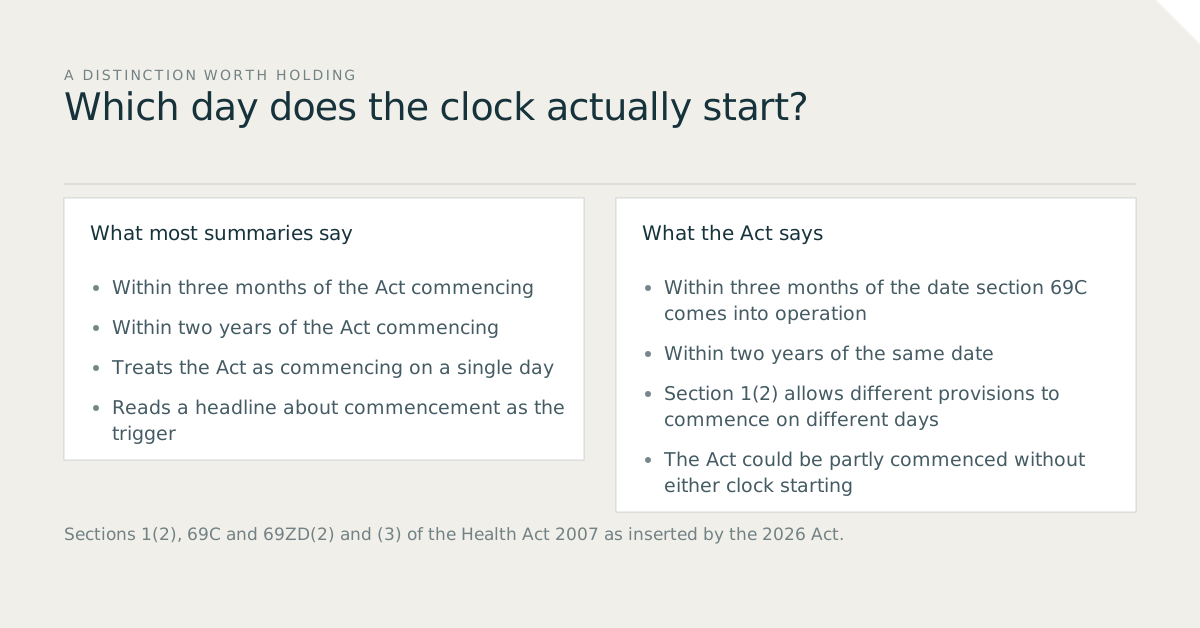
The three month and two year deadlines in home support regulation run from the date on which section 69C comes into operation, not from the date the Act as a whole commences. Section 69ZD(2) and section 69ZD(3) each say so on their face, and section 1(2) makes that distinction operative by allowing different provisions to be commenced on different days.
Section 69C is the prohibition itself. A person shall not carry on the business of a home support provider unless registered. Once section 69C is in operation, registration becomes a condition of trading and the transitional clocks in section 69ZD begin to run.
Nearly all published commentary on home support regulation simplifies this to “within three months of the Act commencing”. That is not what the Act says. The Act could be partly commenced, with definitions, the chief inspector’s functions and the machinery of the register brought into operation first, without either clock starting at all.
The consequence is a timing error rather than a legal one, but it is the kind of timing error that costs weeks. A provider watching for headlines saying the Act has commenced could easily start counting from the wrong day, and three months is not long enough to absorb a false start at either end.
The date to record is the date section 69C comes into operation, as named in the commencement order. Read the statutory instrument rather than the coverage of it. Home support regulation will be reported in summary and enacted in detail, and the detail is where the deadline lives.
What happens in the first three months of home support regulation?
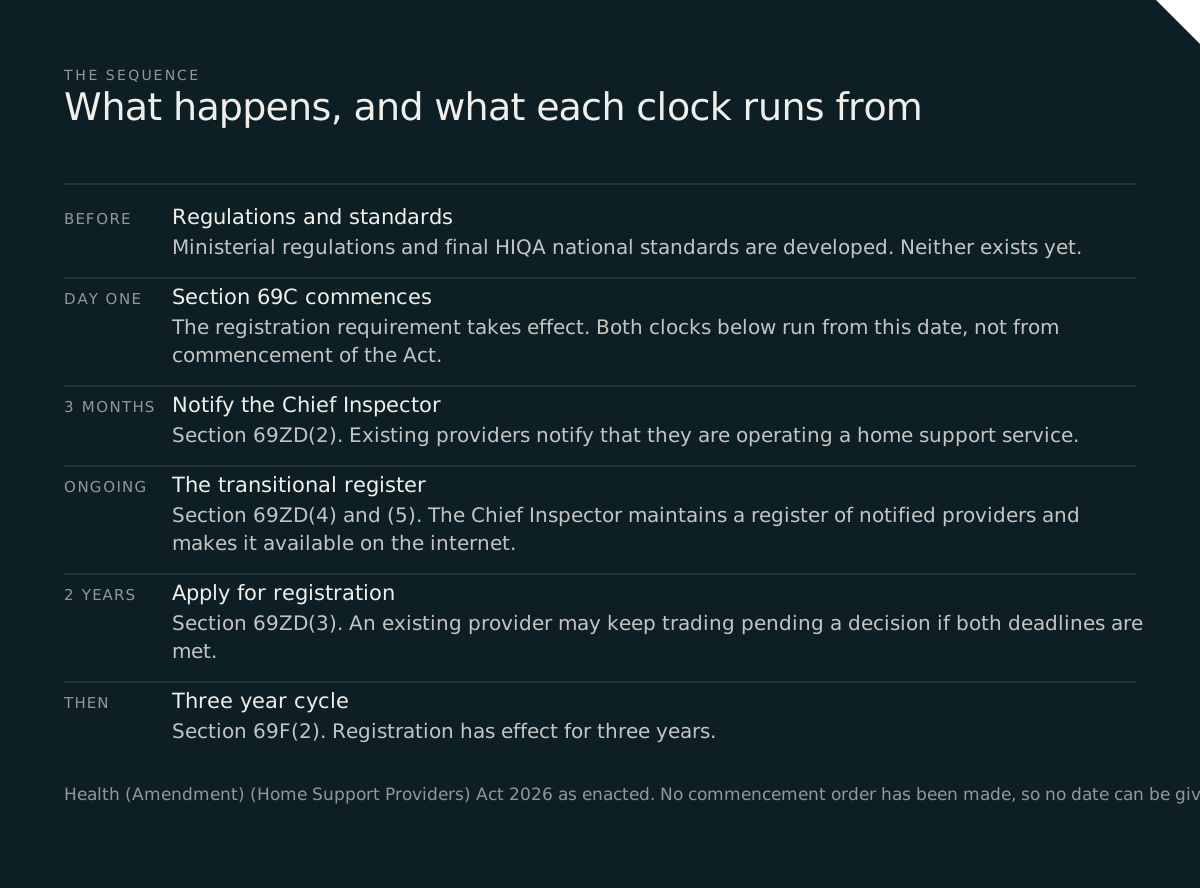
The first three months of home support regulation carry a single obligation for an existing provider, and it is a small one: notify the chief inspector. Section 69ZD(2) requires an existing provider to give that notification no later than three months after the date on which section 69C comes into operation.
Notification is not registration. Registration is the full application under section 69E, supported by whatever evidence the regulations eventually require. Notification is a declaration that the organisation exists, provides a home support service and intends to continue, and it is what buys the right to keep trading while the longer process runs. Home support regulation begins, for most providers, with a form rather than an inspection.
The full sequence, with the section of the Act against each step, runs as follows.
| Trigger | Obligation | Deadline | Section |
|---|---|---|---|
| Section 69C comes into operation | A person shall not carry on the business of a home support provider unless registered | From that date | 69C |
| Section 69C in operation, existing provider | Notify the chief inspector | Not later than 3 months after section 69C commences | 69ZD(2) |
| Notification given | Chief inspector establishes and maintains a register of notified existing providers and makes it available on the internet | Through the transition | 69ZD(4) and (5) |
| Section 69C in operation, existing provider | Apply for registration | Not later than 2 years after section 69C commences | 69ZD(3) |
| Both deadlines complied with | May continue to provide the home support service pending a decision | Until the chief inspector decides | 69ZD(1) |
| Application made | Application must be accompanied by the prescribed application fee | No fee prescribed to date | 69E(2)(c) |
| Registration granted | Registration has effect | 3 years | 69F(2) |
Two rows in that table repay a second reading. Every deadline hangs off the commencement of section 69C rather than the commencement of the Act, and the register described in the third row is a public document.
What is the transitional register, and who can see it?
Section 69ZD(4) and (5) require the chief inspector to establish and maintain a register of existing providers who have notified, and to make that register available on the internet. Anyone with a browser will be able to see which providers have notified and, by inference, which have not.
That is an unusual feature and it is mentioned almost nowhere. Most registration regimes publish a register of registered bodies once registration exists. Home support regulation publishes a register during the transition, before anybody is registered at all, which makes the list a running record of who has taken the first step.
The consequence is worth stating plainly rather than dramatically. Notification under home support regulation is not a private administrative act between a provider and the regulator. Commissioners, service users, families, competitors and journalists will all be able to read the register, and a provider that has not notified will be visible by its absence.
Absence is not proof of anything. A provider might fall inside one of the six exclusions in section 69B(2) and have no obligation to notify at all. The point is narrower: the question will be asked, and the answer is easier to give if the notification was made on time, or if the reason for the absence can be explained in a sentence.
There is a straightforward argument for notifying early rather than at the edge of the deadline, and it costs almost nothing. Home support regulation will produce a first cohort of notified providers and then a long tail. Which of those a provider appears in is a decision made in the first three months.

Can you keep trading while your application is being decided?
Yes. Home support regulation contains an express transitional permission: section 69ZD(1) provides that an existing provider may continue to provide the home support service pending a decision by the chief inspector. That is the single most reassuring line in the transitional scheme, and it is easy to miss.
The permission is conditional. It applies where the provider complies with subsections (2) and (3), which are the three month notification and the two year application. The right to keep trading through home support regulation is bought by meeting both deadlines, and it is bought in that order.
Read the other way round, missing the three month notification is not merely an administrative slip. On the plain wording of section 69ZD, continued trading is tied to compliance with both subsections, and carrying on the business of a home support provider without registration once section 69C is in force is a criminal offence. Whether a late notification can be cured is a question for legal advice. That it is worth avoiding is not.
For most organisations this turns home support regulation into a diary problem before it becomes a compliance problem. One date starts both clocks. One short notification protects the business while the long application is put together properly.
What happens in the two years after that?
The two years after section 69C commences are the window for the full application for registration, under section 69ZD(3). Notification and application are different acts supported by different evidence, and the gap between the two deadlines is where the real work of home support regulation sits.
Two years reads as generous until you notice that it is a shared window. The Department of Health’s Regulatory Impact Analysis estimated about 200 home support providers in Ireland, across HSE, HSE-funded private and voluntary, and private services, with up to 29,000 home support workers across all sectors. Those figures are cited in the Oireachtas Bill Digest of 9 February 2026, and every one of those providers faces the same two year deadline.
Once granted, registration has effect for three years under section 69F(2). Home support regulation is therefore a renewal cycle rather than a one-off event, and that changes what a sensible provider builds. Evidence assembled once, by hand, for a single application is expensive. Evidence the service produces as a by-product of running is cheap, and it is still there in three years.
That distinction is worth designing for now. A supervision record, a competency assessment or a complaint log generated as routine is available whenever it is asked for. One reconstructed for an application has to be reconstructed again at renewal, and reconstructed records read differently to somebody who knows what routine records look like.
What will home support regulation cost?
No fee has been prescribed, so the cost of home support regulation is not yet known. Section 69E(2)(c) requires an application for registration to be accompanied by the prescribed application fee, and section 99(3)(e) allows an annual fee to be prescribed, but both depend on regulations that have not been made.
Treat any quoted figure with suspicion. There is no published fee schedule for home support, so a number offered with confidence is either borrowed from a different sector or invented.
The fee is unlikely to be the significant cost in any event. The costs that can be anticipated now are internal, and they are broadly the same costs whatever the final rules turn out to say.
- Staff time spent assembling and checking records currently held in several places and several formats.
- Training and qualification evidence, including QQI Level 5 major award records where the HSE Authorisation Scheme already requires them.
- Annual competency assessment, already required at appointment and annually under that scheme.
- Garda vetting records, held and retrievable rather than simply obtained at some point.
- Supervision, incident and complaints systems that produce records as a matter of routine.
- Management time on governance, policy review, and the person who will own the application.
None of those costs is created by home support regulation. Every one of them is work a well run service is already doing in some form. What registration changes is that somebody outside the organisation will read the output, and will read it without the benefit of anyone explaining it.
What is worth doing before home support regulation commences?
The work worth doing before home support regulation commences is the work with a long lead time, because that is the work which cannot be compressed into three months. Records made badly cannot be corrected later, since the date a record was made is part of what makes it evidence at all.
Six things are worth starting now. None of them depends on knowing the final rules.
- Training and qualification records that are complete, current and retrievable per member of staff rather than per course.
- Competency assessment on a scheduled cycle, keeping the evidence of the assessment and not only its outcome.
- A complaints and feedback route that is standardised, written down, given to service users and actually used. Standard 1.4 of the draft standards requires arrangements for recording and responding in a timely way, and an empty log is not evidence of a working route.
- Individual support plans developed with the person, reviewed on a stated cycle, and showing the review on the face of the document.
- Incident recording and open disclosure, with evidence that the learning went back into practice.
- A policy set with owners, version numbers and review dates, and a named person accountable for governance.
That list is deliberately dull. Two items on it are harder than they look: a standardised complaints route has to be handed to service users and used before it means anything, and training records have to hold at the level of the individual member of staff rather than the course. Both take months to become routine.
A closing point on sequencing. The three month clock is short but the obligation inside it is small; the two year clock is long but the obligation inside it is large. Providers who treat home support regulation as a single deadline tend to get that the wrong way round, and the price of getting it the wrong way round is a rushed application assembled from reconstructed records.
What the Act requires, section by section, is set out at greater length in our note on the Health (Amendment) (Home Support Providers) Act 2026. Getting the evidence itself into shape is a longer piece of work, and compliance consultancy is where that work sits. Neither replaces reading the commencement order on the day it appears.
CareReady is an Irish compliance and training consultancy working with private home support providers. The work is preparation: governance, records and training evidence brought to a state that holds when an outside reader tests it.
Sources: Health (Amendment) (Home Support Providers) Act 2026, as enacted · William Fry, Home Support Providers Act signed into law