

Whether you are a home support provider inside the scope of the Health (Amendment) (Home Support Providers) Act 2026 is a question with a statutory answer, and the answer is not always the obvious one. The Act creates a registration requirement for any person carrying on the business of a home support provider, and then lifts six categories of activity out of it.
Most published summaries mention two or three of those exclusions. Section 69B(2) of the Act as enacted contains six, and the ones that tend to be left out are exactly the ones an Irish operator needs when it is deciding whether it is a home support provider for the purposes of the new Part 8A.
What follows walks through the statutory definition first and then each of the six exclusions in turn, in plain language, with a note on who each one is really for. Anyone who concludes that they are not a home support provider should be able to point to the paragraph that says so. This is a description of what the Act says. It is not legal advice.
On this page
What counts as a home support service under the Act?
The Act defines a home support service as support provided to a service user by reason of illness, frailty or disability, in relation to activities of daily living, instrumental activities of daily living, or other activities, where the support is primarily provided in the service user’s private dwelling. Four elements do the work in that sentence, and a service has to meet all of them before the question of being a home support provider arises at all. The phrase “other activities” is broad on its face, so a service should not assume it sits outside the definition merely because it does not provide personal care.
- The reason for the support: illness, frailty or disability.
- The activities: activities of daily living, instrumental activities of daily living, or other activities.
- The setting: primarily the service user’s private dwelling, which is the element that separates home support from care delivered somewhere else.
- The recipient: a service user, with no age threshold anywhere in the definition.
The absence of an age threshold is worth pausing on. Home support is usually discussed as a service for older people, because that is how most of it is commissioned, but the statutory definition reaches support given by reason of illness or disability at any age. An organisation supporting younger adults in their own homes can be a home support provider under the Act while sitting entirely outside the HSE’s older persons scheme. The definition sets the population; the exclusions then decide who within it is a home support provider for registration purposes.
Section 69C of the Act as enacted then states the prohibition: a person shall not carry on the business of a home support provider unless registered. Operating unregistered is a criminal offence, and enforcement sits with HIQA through the Chief Inspector of Social Services. That is why the scope question deserves a careful answer rather than an assumption.
Who is excluded from home support provider registration?
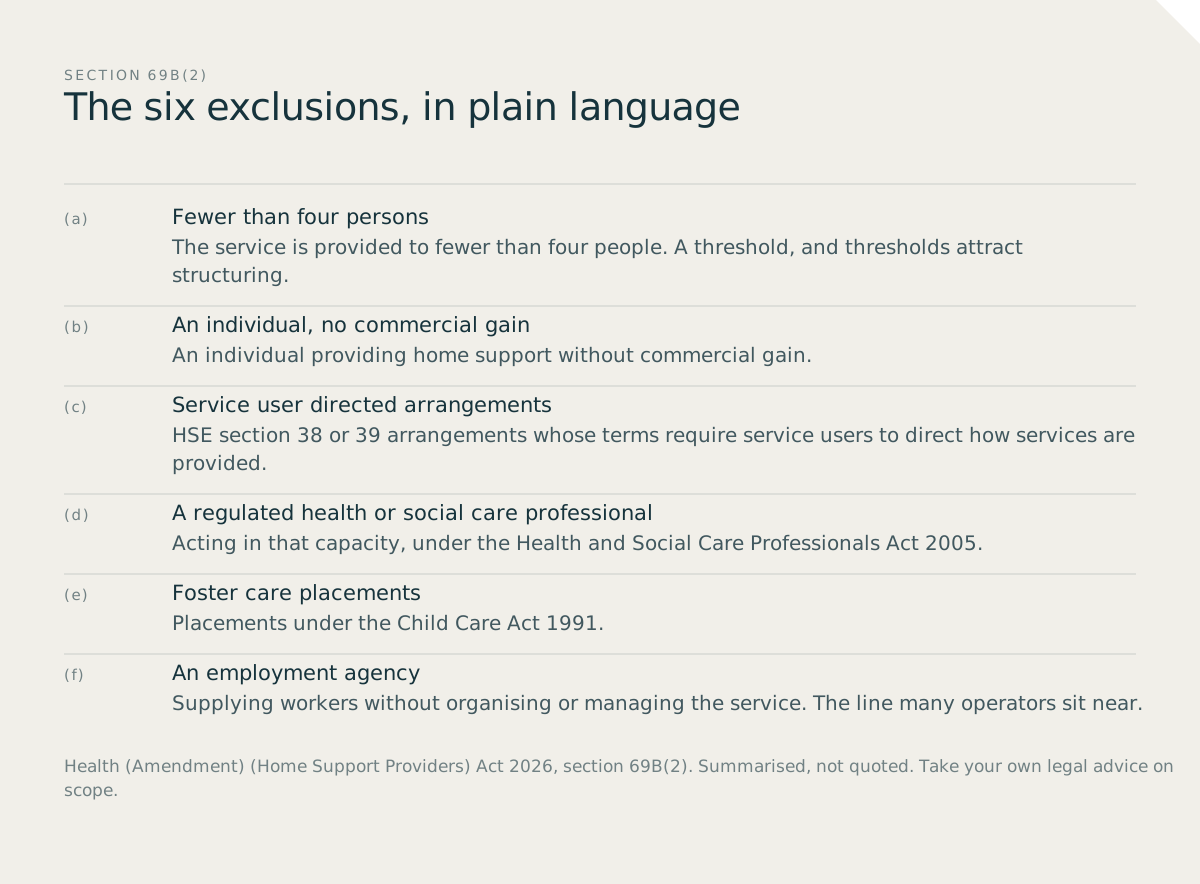
Section 69B(2) sets out six exclusions from the home support provider registration requirement. The six are not ranked and they are not alternatives to one another: a service either falls inside one of them on its own terms or it does not.
| Exclusion | What section 69B(2) says | Plain reading |
|---|---|---|
| (a) | The person provides a home support service to fewer than 4 persons | A home support provider supporting three or fewer people sits outside the requirement. The fourth person brings it inside. |
| (b) | The person is an individual who provides a home support service without commercial gain | Unpaid support given by an individual. A company is not an individual, whatever its profit status. |
| (c) | A person providing services under HSE section 38 or section 39 arrangements where the terms require the service users themselves to direct how services are provided | Preserves personal assistant services, where the person receiving support directs the work. |
| (d) | The person is providing a home support service in that person’s capacity as a member of a relevant profession within the meaning of the Health and Social Care Professionals Act 2005 | The regulated professional acting as a professional, not the home support provider that employs them. |
| (e) | Foster care placements under the Child Care Act 1991 | Already governed elsewhere. No second registration regime is laid over it. |
| (f) | A person carrying on the business of an employment agency who is not involved in organising or managing the provision of a home support service | Supplying workers sits outside. Organising or managing the service makes the business a home support provider. |
Two of the six do most of the practical work in Ireland. The threshold at paragraph (a) decides scope for small operators, and the employment agency exclusion at paragraph (f) decides it for a whole category of businesses that supply care workers without ever describing themselves as a home support provider.

What does the fewer than four persons exclusion actually mean?
Paragraph (a) excludes a person who provides a home support service to fewer than four persons. Read plainly, that is three or fewer people receiving the service, so an operator at four is inside the registration requirement while an operator at three is outside it.
A numerical threshold of that kind creates an obvious incentive. A home support provider close to the line can stay below it by capping client numbers, or by arranging matters so that no single entity supports four people. That is not a recommendation and nothing here should be read as one. It is a prediction about behaviour, and it is something the sector and the Chief Inspector will have to watch as the transitional register fills.
The more useful point for an honest operator is that the line is an uncomfortable place to sit. Client numbers move. A service that hovers at three or four crosses in and out of a statutory duty as people join and leave it, and the consequence of being wrong about which side you are on is criminal rather than commercial. A home support provider that expects to grow past three clients is better served by preparing as though the exclusion does not apply to it.
Am I an employment agency or a home support provider?
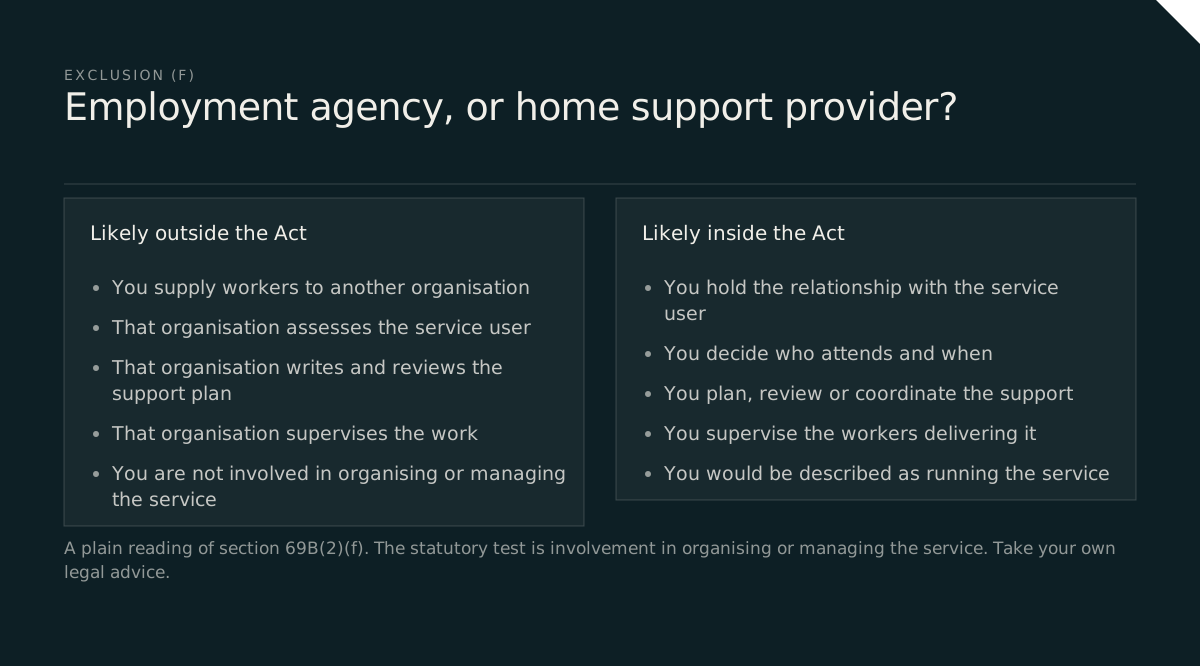
Paragraph (f) excludes a person carrying on the business of an employment agency who is not involved in organising or managing the provision of a home support service. The hinge is the second half of that sentence: involvement in organising or managing, not the label over the door.
A number of Irish businesses sit close to this line, supplying carers to families who then treat the agency as the service provider in everything but name. The exclusion is written around what the business is involved in doing, so the working test is practical rather than contractual.
Activities that point towards organising or managing, and therefore towards being a home support provider, include the following:
- Deciding which worker attends which service user, and when.
- Preparing, reviewing or supervising the care plan.
- Receiving and handling complaints about the work done in the home.
- Monitoring quality, carrying out spot checks or supervising practice.
- Being the party the family telephones when something goes wrong.
An agency that supplies a worker to a client who then rosters, directs and supervises that worker is doing something different. An agency doing any real part of the list above is behaving like a home support provider whatever its contracts say, and it should expect the question to be asked. Paragraph (f) is the one most likely to surprise people, because the business model grew up long before the Act existed.
Does the personal assistant exclusion apply to my service?
Paragraph (c) excludes a person providing services under HSE section 38 or section 39 arrangements where the terms of those arrangements require the service users themselves to direct how the services are provided. The exclusion exists to preserve personal assistant services, in which the person receiving support decides how that support is delivered.
Two conditions have to be met together. The funding arrangement has to be a section 38 or section 39 arrangement, and its terms have to require service user direction. An organisation that holds a section 39 arrangement but organises the work itself does not come within paragraph (c), and neither does an organisation running a self-directed model outside those funding arrangements. Neither condition carries the exclusion on its own, and a home support provider reading paragraph (c) as a general exemption for disability services has misread it.
Mixed organisations should read this carefully. Holding one qualifying arrangement does not place a whole organisation outside the Act, because the exclusion attaches to the service being provided rather than to the corporate entity. An organisation running personal assistant services under paragraph (c) alongside conventional home support is still a home support provider in respect of the conventional work.
What about health and social care professionals?
Paragraph (d) excludes a person providing a home support service in that person’s capacity as a member of a relevant profession within the meaning of the Health and Social Care Professionals Act 2005. The operative words are “in that person’s capacity as”, which tie the exclusion to the role the individual is acting in.
That is a narrower exclusion than it first appears. Paragraph (d) removes the regulated professional acting as a professional, not every organisation that happens to employ one. A home support provider that employs or engages members of a relevant profession is not excluded by it, because the business being carried on is still the provision of a home support service. The practical effect is narrow. Paragraph (d) answers a question about the capacity in which an individual is acting, not the question of whether an organisation is a home support provider.
What about foster care and unpaid support?
Paragraph (e) excludes foster care placements under the Child Care Act 1991, and paragraph (b) excludes an individual who provides a home support service without commercial gain. Both are narrow, and both are drafted in terms that repay a close reading.
Paragraph (b) applies to an individual rather than to a body corporate, and only where there is no commercial gain. A neighbour or a family friend providing support unpaid is plainly within it. An organisation that describes itself as not for profit is not an individual, and the exclusion does not reach it on the face of the words.
Paragraph (e) is more self-contained. Foster care placements are already governed by the Child Care Act 1991, and the Act avoids laying a second registration regime over them. Neither paragraph is likely to be the answer for a commercial operator asking whether it is a home support provider.

Does it matter that I am already on an HSE approved provider list?
A place on an HSE approved provider list does not answer whether you are a home support provider, because it is a commissioning arrangement rather than a statutory registration. The HSE Authorisation Scheme is a procurement condition set by a purchaser, and it decides who the HSE will buy hours from, not who may carry on the business.
The Home Support Services for Older People Authorisation Scheme Standard Operating Procedure, Version 4.0, published in September 2025, requires a QQI Level 5 major award including the Care Skills and Care of the Older Person modules, a fully completed National Carer Competency Assessment at appointment and annually, and Garda vetting or police clearance. Those are real requirements, and meeting them says a good deal about a home support provider’s staffing records. It says nothing at all about its statutory position, because they are conditions of being bought from.
HSE approved provider lists are also regional, and providers frequently appear on more than one. Holding several places across several regions tells you that several purchasers are content to buy from you. It tells you nothing about whether you are a home support provider within the meaning of the Act, which is a question about what you do rather than about who pays for it.
When does a home support provider have to answer this question?
The scope question has to be answered before the first statutory deadline falls, because the duty to notify applies to providers inside the Act. Section 69ZD(2) requires an existing provider to notify the chief inspector no later than three months after the date on which section 69C comes into operation.
Section 69ZD(3) then requires an application for registration no later than two years after that same date, and section 69ZD(1) allows an existing provider to keep operating while the chief inspector considers the application, provided it has complied with both. Both clocks run from the commencement of section 69C specifically, not from commencement of the Act as a whole, and section 1(2) allows the Minister to commence different provisions on different days.
No commencement order has been made and the timing is not yet known. At Committee Stage the Minister of State said that a commencement period of up to twelve months was envisaged, to allow ministerial regulations, HIQA national standards and guidance to be developed, as reported by William Fry in July 2026. The structure and duties of the Act are set out in more detail in our guide to the Act.
The risk in getting scope wrong is asymmetric. A home support provider that decides it is outside the Act, and turns out to be inside it, has missed a statutory notification while believing it had no duty at all. Sections 69ZD(4) and (5) also require the chief inspector to maintain a register of providers who have notified and to publish it on the internet, so absence from that list will be visible.
What should a home support provider do if it is not sure?
A provider that is genuinely unsure about its position should take its own legal advice on it, and should do that before the notification clock starts rather than after. Preparatory work makes the advice cheaper and better, because most of the cost of a scope opinion is the time spent establishing what the service actually does.
- Write the four elements of the statutory definition down and test the real service against each one, in writing.
- Check each of the six exclusions against its own wording rather than against a summary of it.
- Count the people you support, record how you counted them, and record the date you counted.
- Describe honestly who decides which worker attends whom, who supervises practice and who takes complaints.
- Keep the reasoning, dated, so the position you reached can be explained to somebody else later.
The Department of Health’s Regulatory Impact Analysis estimated that about 200 organisations provide home support in Ireland, across the HSE, HSE-funded private and voluntary services, and private operators, with up to 29,000 home support workers across all sectors. Those figures are cited in the Oireachtas Bill Digest of 9 February 2026. The register built from that population will be the first complete picture the sector has had of itself.
Scope is the first decision rather than the last. Everything after it, from notification through to the evidence a home support provider eventually puts in front of the Chief Inspector, depends on having answered it correctly and being able to show the reasoning. Our compliance consultancy work starts there, and the contact page is the place to begin that conversation.
CareReady is an Irish compliance and training consultancy working with private home support organisations. The work is unglamorous and specific: reading what the rules actually say, and getting the evidence into a state that survives being read by somebody outside the organisation.
Sources: Health (Amendment) (Home Support Providers) Act 2026, as enacted · Oireachtas Library and Research Service Bill Digest